
Last updated July 25, 2026
Automotive Locksmith Warning Signs Every Homeowner Should Know
Here’s a scenario that plays out daily across Los Angeles: a driver searches “locked out of car near me,” dials a number with a local area code, and watches a technician drill their door lock for a simple lockout - then hands them a bill for $400. The real cost should have been $85. No drilling was necessary. This is not an outlier. In our 42 years serving Los Angeles, we’ve repaired the damage from these scams more times than we can count. This guide shows you exactly how automotive locksmith scams work, the five phrases that expose them, and how to verify a legitimate technician before they touch your vehicle.
Quick Answer
The most reliable automotive locksmith warning signs are: a price that changes after arrival, insistence on drilling standard locks, cash-only demands, refusal to provide a California BSIS license number, and a “local” phone number that routes to a national call center. A legitimate Automotive Locksmith in Los Angeles quotes a flat price before dispatching, arrives in a marked vehicle with uniformed ID-presenting technicians, and almost never needs to drill a standard car door lock.
Table of Contents
- Why Automotive Scams Follow a Different Playbook
- The “Local Number, National Call Center” Trap
- Five Phrases That Signal a Scam
- The Unnecessary Drilling Upsell
- How to Verify a California Automotive Locksmith License
- Your Rights When the Price Jumps
- What a Legitimate Automotive Locksmith Looks Like
- Common Mistakes to Avoid
- When to Call a Professional
- Frequently Asked Questions
- The Bottom Line
Why Automotive Scams Follow a Different Playbook
Residential locksmith scams target homeowners who have time to compare quotes, check reviews, and verify credentials. Automotive scams operate on urgency and distraction. A driver locked out on the 405 at rush hour, or in a dark parking structure in Downtown Los Angeles, is not going to spend twenty minutes researching. They’re going to call the first number that looks local and promises fast arrival.
This dynamic creates a predatory ecosystem. Scam operators know that stressed drivers make fast decisions, rarely file complaints, and often don’t know their vehicle’s actual key replacement cost. A transponder key for a 2019 Honda Accord might cost $180-$240 from a legitimate locksmith. Scam operators quote $60 over the phone, then present a $450 invoice claiming “programming fees,” “emergency dispatch charges,” and “labor overruns.”
The geography of Los Angeles amplifies this problem. Spread across 500 square miles with notorious traffic congestion, drivers are frequently stranded in unfamiliar neighborhoods - from the industrial corridors of Vernon to the hillside roads of Laurel Canyon. A driver in Encino who calls a “local” number with a 818 area code may be connected to a dispatch center in Florida, which then subcontracts to an unlicensed operator who happens to be nearest the GPS pin.
We’ve seen the aftermath. A retired teacher in Silver Lake called what she believed was a neighborhood locksmith after locking her keys in her Prius at the grocery store. The technician who arrived had no uniform, no marked vehicle, and no license to show. He drilled her door lock - destroying a perfectly functional mechanism - and charged $380. We replaced the lock with a proper OEM-grade component and programmed her key for $165. Done right - and backed in writing.
The automotive scam playbook exploits three specific vulnerabilities: the driver’s urgent need to move, their limited knowledge of modern vehicle security systems, and the opacity of key programming costs. Understanding these vulnerabilities is the first step to protecting yourself.
The “Local Number, National Call Center” Trap
This is the most common automotive locksmith scam structure in high-traffic Los Angeles areas, and the hardest to detect before it’s too late. Here’s how it works:
- A national lead-generation company purchases dozens of local phone numbers across Southern California - 213, 310, 323, 424, 626, 818 - and creates websites with generic names like “Los Angeles Emergency Locksmith” or “Valley Auto Lock Experts.”
- These sites rank highly in Google Maps and search results through aggressive SEO and paid advertising. The addresses listed are often virtual offices, mailboxes, or simply fabricated.
- When you call, you reach a call center - sometimes in another state entirely - where operators read from scripts designed to sound local. They may mention “the 405 traffic” or “we’re near LAX” to build false familiarity.
- The call center dispatches the job to the lowest-bidding subcontractor within their network, not the most qualified technician. These subcontractors are often unlicensed, uninsured, and paid a percentage of whatever they can collect.
- The subcontractor arrives in an unmarked personal vehicle, frequently without proper tools, and the scam unfolds from there.
How to detect this before the truck arrives:
- Ask for a specific street address and verify it on Google Street View. Virtual offices and mailboxes are immediate red flags.
- Ask where the technician is dispatching from right now. A legitimate operation can tell you. A call center operator reading from a screen cannot.
- Listen for background noise that sounds like a large call floor rather than a local shop.
- Check how long the business has operated at that address. Strongbox Lock & Safe Co. has served Los Angeles from established locations for over 42 years. Fly-by-night operations often have addresses less than two years old.
- Search the business name with “complaint” or “scam” before calling. Pattern complaints about price changes after arrival are definitive warnings.
In our experience, the worst concentration of these operations targets the corridors around Los Angeles International Airport, the tourist zones of Hollywood and Santa Monica, and the business districts of Downtown - anywhere with high transient traffic and stressed drivers who won’t be in town to follow up on complaints.
Five Phrases That Signal a Scam
After four decades in this trade, we’ve learned that scam operators use remarkably consistent language. These five phrases should stop the conversation immediately:
“I’ll give you a price when I see it.”
This is the classic bait-and-switch opener. A legitimate automotive locksmith can quote a firm price for standard services - lockouts, key duplication, transponder programming - based on your vehicle make, model, and year. The only variables should be your location (for travel time) and whether you need emergency after-hours service. At Strongbox, we quote a flat price on the phone before any work begins. The price we quote is the price you pay.
“The lock has to be drilled.”
For a standard car door lockout, this is almost never true. Modern automotive locksmiths use long-reach tools, air wedges, and specialized picks that open vehicles without damage. Drilling should be reserved for extreme cases - seized locks, severe damage, or high-security vehicles with specific vulnerabilities. We’ve opened thousands of vehicles in Los Angeles without drilling a single standard lock. If a technician’s first suggestion is drilling, they either lack proper tools or are manufacturing a need for expensive replacement parts.
“Cash only.”
This serves two scam purposes: it avoids credit card chargebacks (your primary recourse for fraudulent charges) and it enables tax evasion. Legitimate businesses accept multiple payment methods and provide detailed invoices. We accept all major payment methods and provide written receipts with every job - part of our 90-Day Done Right Promise.
“I don’t have a license number handy.”
Every legitimate California locksmith carries their Bureau of Security and Investigative Services (BSIS) license and must present it upon request. “I left it in the truck” or “the office has it” are unacceptable. A technician who cannot immediately produce a pocket license card is operating illegally in California.
“The key machine is on the truck.”
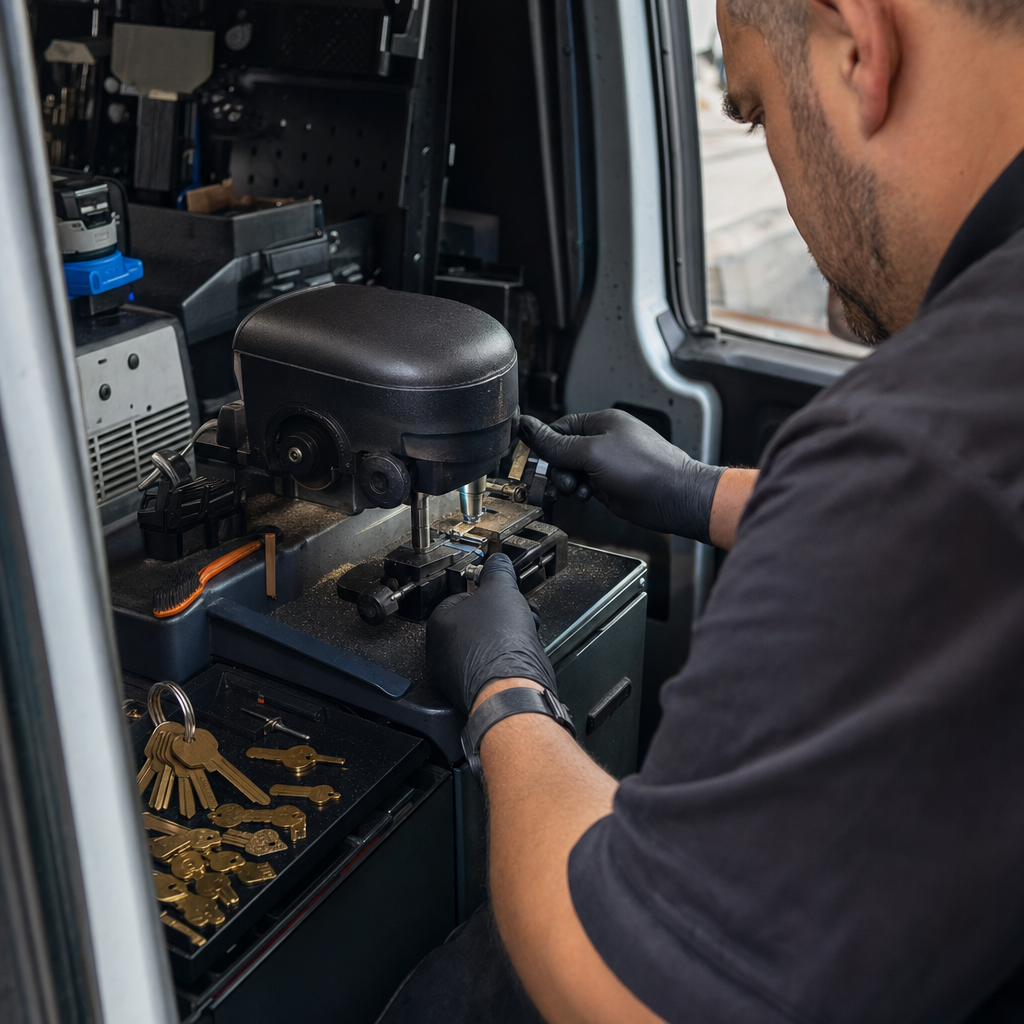
This phrase, used to justify why programming costs can’t be quoted in advance, often masks equipment that is inadequate or nonexistent. Modern automotive key programming requires specific software licenses, manufacturer databases, and hardware that costs $10,000-$30,000. A technician with proper equipment knows exactly what their costs are and can quote accordingly. Vague references to “the machine” suggest either obsolete tools or an intention to inflate charges once you’re committed.
The Unnecessary Drilling Upsell
This deserves its own section because it’s the most destructive and profitable scam tactic in automotive locksmithing. Understanding what unnecessary drilling looks like can save you hundreds of dollars and preserve your vehicle’s integrity.
A standard car door lockout involves manipulating the lock mechanism to release the latch without a key. Professional automotive locksmiths use an array of specialized tools: long-reach rods that access interior unlock buttons, air wedges that create gentle gaps in door seals, and decoder picks that read the lock’s internal pattern. The process typically takes 2-10 minutes for common vehicles.
Drilling destroys the lock cylinder, requiring complete replacement. The scam technician then sells you a new lock assembly - often aftermarket quality at inflated prices - plus additional labor. A simple $85 lockout becomes a $400-$600 “repair.”
When is drilling actually necessary? Almost never for a simple lockout. Legitimate exceptions include:
- Locks damaged in attempted theft or vandalism, which we see occasionally in parking structures around MacArthur Park and the Fashion District
- Severely corroded mechanisms in vehicles exposed to coastal salt air for extended periods - rare, and typically affecting vehicles 20+ years old
- High-security locks with specific anti-pick designs, though even these usually have manufacturer-specified bypass procedures
- Locks with broken keys jammed internally that cannot be extracted
If a technician reaches for a drill within the first two minutes of arrival, stop them. Ask specifically why non-destructive methods won’t work. A skilled technician can explain the obstacle and should be willing to attempt non-destructive methods first. At Strongbox, our background-checked, uniformed technicians carry the full range of professional tools - including picks and decoders for Mul-T-Lock and other high-security automotive applications - and we drill only as an absolute last resort, with your explicit understanding of why.
The cost difference is substantial. A standard Los Angeles lockout runs $75-$125 during business hours, $125-$175 after hours. Replacing a drilled lock assembly adds $150-$350 in parts and labor. Protecting yourself starts with knowing what proper service looks like.
How to Verify a California Automotive Locksmith License
California requires all locksmiths to hold a BSIS license. Verification takes under two minutes and is your most powerful protection against scams. Here’s exactly how to do it:
- Visit the BSIS license lookup page: Go to the California Department of Consumer Affairs website and navigate to the “Verify a License” tool. Search for “Bureau of Security and Investigative Services.”
- Enter the license number: Ask the technician or company for their BSIS locksmith license number before any work begins. Legitimate operators provide this immediately.
- Check three specific details: Confirm the license status is “Active,” verify the expiration date has not passed, and ensure the name matches the person or business you’re dealing with. Mismatches suggest borrowed or stolen license numbers.
- Verify the license type: California issues specific categories. An “Automotive Locksmith” or “Locksmith” classification covers vehicle work. Other classifications may not.
- Save a screenshot: Document your verification. If problems arise later, this proves you performed due diligence.
What if they refuse to provide a license number? End the call. This is non-negotiable under California law. Operating as a locksmith without a BSIS license is a misdemeanor, and unlicensed operators are uninsured - meaning damage to your vehicle leaves you with no recourse.
We encourage every caller to verify our license. Our technicians present ID at the door on every visit, and we’re happy to provide our BSIS number before dispatch. A square deal starts with transparency.
Your Rights When the Price Jumps
Most drivers don’t know that California law provides specific protections against locksmith bait-and-switch tactics. Understanding these rights can save you from paying fraudulent charges.
Under California Business and Professions Code Section 9880 et seq., locksmiths must provide a written estimate before beginning work if the total will exceed $25. This estimate must include all labor, parts, and service charges. If the final invoice exceeds the estimate by more than 10%, you have grounds to dispute.
More critically, if a technician presents a price substantially higher than the phone quote - the classic bait-and-switch - you are not legally obligated to pay the inflated amount. Specifically:
- You may demand the service be completed at the quoted price. If the technician refuses, they must release your vehicle without charge (though they may remove any parts they’ve installed).
- You may pay under protest - clearly writing “paid under protest, dispute amount” on the receipt - and file a complaint with BSIS and the Los Angeles County District Attorney’s Consumer Protection Division.
- For credit card payments, you may initiate a chargeback with your card issuer, providing documentation of the phone quote versus the final invoice.
- For cash payments, your recourse is more limited, which is why scam operators prefer cash. This is another reason to never agree to “cash only.”
Document everything. Save the phone number you called, screenshot any web page or advertisement, record the technician’s name and vehicle description, and photograph their business card or any documentation. In Los Angeles, the Department of Consumer and Business Affairs also accepts complaints, and pattern reports against specific operators can trigger investigations. For additional protection tips, see our more guides & resources.
At Strongbox, we eliminate this risk entirely. The price we quote on the phone is the price on the invoice - no exceptions, no surprises. We stand behind it, no paperwork, no arguing.
What a Legitimate Automotive Locksmith Looks Like
After decades serving Los Angeles drivers, we’ve developed a clear picture of what professional automotive locksmith service entails. Use this as your comparison standard, and consult our Commercial Locksmith Maintenance Schedule: What to Do and When for ongoing security planning:
Before arrival: A live person answers your call - no voicemail trees, no callback queues. They ask your vehicle make, model, year, and location. They quote a flat price that includes all labor, programming, and key blanks. They provide an estimated arrival window and a technician name. At Strongbox, calls are answered by a live person, 24/7, including nights, weekends, and holidays.
At arrival: The technician arrives in a marked company vehicle, wearing a uniform, and presents identification including their BSIS license. They confirm the quoted price before touching your vehicle. They explain what they plan to do and why. Our background-checked, uniformed technicians show ID at the door on every visit - because the person who opens your locks should be the most verifiable person you have ever hired.
During service: Work proceeds efficiently with professional tools. The technician explains any unexpected complications and obtains your approval before additional charges. For transponder keys, programming is performed with manufacturer-authorized equipment, not generic “universal” tools that may compromise your immobilizer system.
After completion: You receive a detailed written invoice, a written guarantee, and instructions for any follow-up. We provide our 90-Day Done Right Promise on every job - backed in writing, no arguing, no extra paperwork. If it’s not right, we come back.
We install and service top-tier security hardware when lock replacement is genuinely needed: Baldwin, Mul-T-Lock, Sargent, and other premium brands. The right lock goes on the right door, not just what’s on the truck. See our guide on Choosing the Right Locksmith Brand: A Buyer’s Guide for Los Angeles for details on selecting quality hardware.
Automotive Locksmith in Los Angeles
Common Mistakes to Avoid
- Calling the first Google result without verification. Top placement often goes to the highest bidder, not the most qualified operator. Spend three minutes checking reviews, license status, and how long the business has operated at its stated address.
- Accepting a “too low” phone quote. A $19 or $29 service call is mathematically impossible for a legitimate business covering Los Angeles traffic and labor costs. These quotes exist solely to get a technician to your location where the real pricing begins.
- Not asking about drilling before dispatch. A simple question - “Will you need to drill my lock?” - filters out unprepared technicians. A legitimate locksmith’s answer for a standard lockout is “almost certainly not.”
- Paying cash without a detailed receipt. Cash payments to unlicensed operators are untraceable and unrecoverable. Always demand a written receipt with the business name, address, license number, and itemized charges.
- Ignoring your instincts about the technician. Unmarked vehicle, no uniform, evasive about credentials, pressure to decide quickly - any of these is reason to decline service and call someone else. In a city the size of Los Angeles, legitimate alternatives are always available.
- Not programming a spare key immediately after a lockout. The cost of duplicating a working key is a fraction of creating one from scratch after total loss. We see drivers in Venice and Pasadena who repeat the same emergency every six months because they never made that spare.
- Assuming dealership service is your only alternative. Dealership key replacement typically costs 40-60% more than a qualified automotive locksmith and requires towing. A legitimate locksmith provides equivalent programming at substantial savings, with mobile service that comes to you.
When to Call a Professional
Some situations demand immediate professional assistance: children or pets locked inside a vehicle (call 911 first, then a locksmith), keys broken off in the ignition, transponder failure preventing engine start, or lock damage from theft attempts. In these scenarios, speed matters, but so does choosing correctly under pressure.
Program a trusted locksmith’s number into your phone before you need it. When you’re stranded on the shoulder of the 101 at night is not the moment to evaluate options carefully. Strongbox Lock & Safe Co. home offers free estimates in Los Angeles - call (877) 664-8139. We’ll quote a flat price before dispatching, and we’ll be there when we say.
Frequently Asked Questions
A standard car lockout in Los Angeles typically costs $75-$125 during regular hours and $125-$175 for nights, weekends, or holidays. Transponder key programming runs $180-$340 depending on vehicle complexity. If you’re quoted significantly less, expect the price to change after arrival. Call (877) 664-8139 for an exact quote - estimates are free.
Yes. A licensed automotive locksmith with proper equipment can generate a new key from your vehicle’s VIN and immobilizer data. This requires manufacturer database access and specialized programming tools - services that legitimate operators perform regularly. The process takes 30-90 minutes and costs $200-$450 depending on key type. We perform this service across Los Angeles, from the Valley to the South Bay.
They almost certainly don’t. Drilling is a destructive shortcut used by technicians lacking proper tools or training, or deliberately to create a need for expensive replacement parts. A skilled automotive locksmith opens standard vehicle locks non-destructively in minutes. At Strongbox, we’ve opened thousands of vehicles without drilling. If a technician’s first suggestion is drilling, get a second opinion - our Free Second Opinion on Any Written Estimate applies.
Ask for a specific street address and verify it on Google Street View. Ask where the technician is dispatching from right now. Listen for call-center background noise. Check how long the business has operated at that address. Strongbox Lock & Safe Co. has served Los Angeles communities for over 42 years from established locations - we can tell you exactly where your technician is coming from.
No. Dealership key replacement typically costs 40-60% more than a qualified locksmith and requires towing your vehicle. A mobile automotive locksmith comes to your location with equivalent programming capability. For most vehicles in Los Angeles, we save customers $150-$300 over dealership pricing with same-day service.
Do not pay under pressure. In California, you have the right to demand service at the quoted price or to have your vehicle released without charge. Pay under protest if necessary, documenting everything, and file complaints with BSIS and local consumer protection. Better yet, avoid the situation: Strongbox quotes a flat price on the phone before any work begins, and the price we quote is the price you pay.
The Bottom Line
Automotive locksmith scams in Los Angeles prey on urgency, ignorance, and trust. The protections are straightforward: verify the BSIS license before dispatch, demand a flat phone quote, reject drilling for standard lockouts, and never accept cash-only demands. The five warning phrases - “I’ll give you a price when I see it,” “the lock has to be drilled,” “cash only,” “I don’t have a license number handy,” and “the key machine is on the truck” - are your immediate signal to end the call.
A legitimate automotive locksmith operates transparently, quotes honestly, and stands behind their work. That’s how we’ve built Strongbox Lock & Safe Co. for over 42 years. Named for the iron box where your grandfather kept the deed - we plan to be in your community in thirty years and act like it.
Written by the team at Strongbox Lock & Safe Co., serving Los Angeles since 2013.