
Last updated July 25, 2026
Commercial Locksmith Troubleshooting: Common Problems and How to Fix Them
A panic bar that requires more than 15 pounds of pressure to operate is not just a maintenance issue - it’s a code violation under California Fire Code Section 1010.1.10, and a business owner who was notified of the problem and didn’t fix it carries meaningful liability if someone is injured during an evacuation. In our 42 years serving Los Angeles businesses, from the garment district downtown to the studios in Burbank, we’ve seen how a single malfunctioning lock can shutter operations, trigger OSHA inquiries, or void an insurance claim. This guide teaches your staff to identify commercial lock problems precisely, document them correctly, and know immediately when the fix is in-house versus when it requires a Commercial Locksmith with a C-28 license.
Quick Answer
Most commercial lock problems fall into five categories: exit device malfunctions, electronic access failures, master key system errors, cylinder wear in high-traffic deadbolts, and door closer misalignment. Staff can resolve roughly 20% of these with basic testing and adjustment - the other 80% require a licensed commercial locksmith to maintain code compliance, insurance validity, and liability protection. For deeper reading, see our Commercial Locksmith Warning Signs Every Homeowner Should Know.
Table of Contents
- Exit Device Malfunctions and Fire Code Compliance
- Electronic Access and Keypad Failure Hierarchy
- Master Key System Failures: Logical Diagnosis
- High-Traffic Cylinder Wear: Predicting Failure Before It Happens
- Door Closer Problems That Damage Locks
- Documenting Lock Problems for Insurance and Liability
- Common Mistakes to Avoid
- When to Call a Professional
- Frequently Asked Questions
Exit Device Malfunctions and Fire Code Compliance
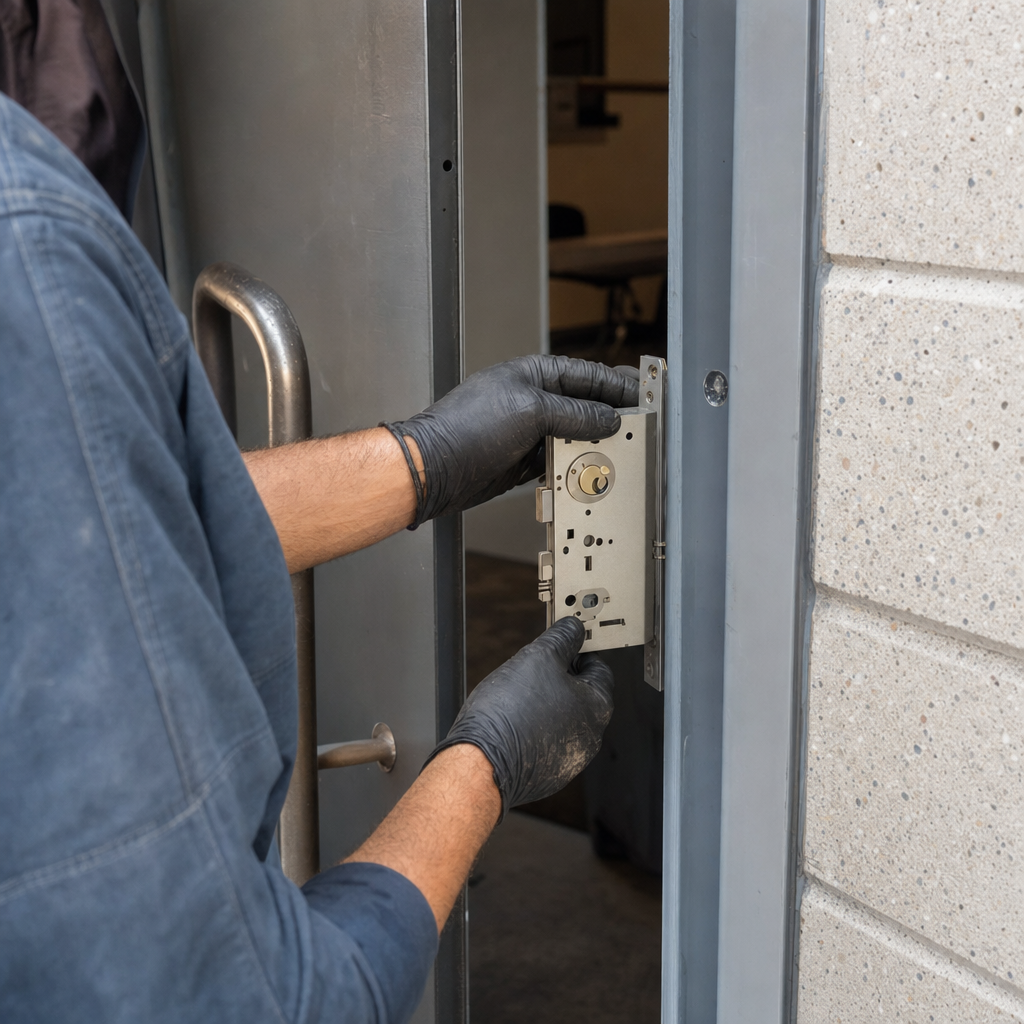
Exit devices - panic bars and crash bars - are the most regulated hardware in your building. California adopts NFPA 101 and the California Fire Code with minimal modification, which means the 15-pound maximum actuation force applies everywhere from Santa Monica office parks to San Fernando Valley warehouses. A bar that sticks, squeaks, or requires a shoulder to open is not a “tomorrow” problem.
The Three-Step Force Test (In-House)
- Place a fish scale or luggage scale on the touchpad at the center, where pressure is normally applied.
- Press steadily until the latch retracts and the door unlatches. Read the scale at the moment of release.
- If the reading exceeds 15 pounds, or if the bar travels unevenly (catches at one side first), the device needs service.
Common causes we find in Los Angeles include paint buildup on the touchpad rail, a misaligned latch keeper that the bolt is dragging against, and debris from Santa Ana wind events that blows through door gaps and packs into the mechanism. The latch keeper misalignment is the one your maintenance staff can sometimes correct: loosen the keeper screws, shift the plate so the bolt enters without contact on any side, and retighten. If the bar still requires excessive force after this adjustment, the internal mechanism is binding - and California code requires that repair be performed by a licensed technician who can certify the device to the AHJ (Authority Having Jurisdiction).
Surface-mounted versus concealed vertical rod devices differ significantly. A surface-mounted Von Duprin 99 or similar can often be adjusted in place. Concealed vertical rod devices, common in newer Los Angeles commercial construction for cleaner sightlines, require door disassembly to access the rods and bottom latch. Attempting this without proper tools risks bending the rods, which then fail to engage the floor strike - a silent failure that won’t show until an emergency evacuation.
One specific Los Angeles consideration: buildings constructed before 1990 often have exit devices that predate current ADA and fire code requirements. These are grandfathered only until replacement; when a device is replaced, the new installation must meet current standards. We’ve replaced original hardware in downtown Los Angeles buildings where the exit device was original to the 1973 construction. The owner assumed replacement parts would suffice. They won’t - the new device must be code-compliant, and that typically means a different mounting pattern, which means door modification, which means a licensed contractor.
Electronic Access and Keypad Failure Hierarchy
Electronic access failures generate the most expensive misdiagnoses in commercial locksmithing. A manager who calls the wrong vendor - the IT company for a reader fault, or the locksmith for a network outage - loses a business day and often pays two trip charges. The three-step test separates credential, reader, and controller faults in under five minutes.
Step 1: Test the Credential
Try the card or fob on a different reader at the same facility. If it works elsewhere, the credential is good. If it fails on multiple readers, the credential is dead - demagnetized, expired in the system, or deactivated. In Los Angeles, we’ve found that proximity cards stored next to smartphones fail prematurely; the phone’s internal magnets degrade the card’s antenna coil. This is especially common in media and entertainment businesses where employees carry multiple devices.
Step 2: Test the Reader
If the credential works elsewhere, return to the failed reader and test a known-good credential. A second dead card suggests reader failure. Listen: a healthy proximity reader emits a faint click or beep when powered. Silence means no power. Check the reader’s LED - solid red or no light typically indicates power loss; flashing red after card presentation indicates the reader sees the card but cannot communicate with the controller.
Step 3: Test the Controller
If the reader has power and responds to cards but won’t unlock the door, the problem is upstream. Controller faults require the access control vendor or a commercial locksmith with electronic credentials - not the IT department, unless your IT staff holds low-voltage contractor licensing. For vehicle access issues, see The Complete Automotive Locksmith Guide for Los Angeles Homeowners.
Keypad failures follow a simpler hierarchy. A keypad with no backlight has no power. A backlight with no response to button presses has a failed membrane or moisture intrusion - common in Los Angeles coastal locations where marine layer condensation collects in surface-mounted units. A keypad that accepts the code but won’t unlock the door has a wiring or lock power fault. Document which symptom you observe before calling; it determines whether we bring a power supply, a replacement keypad, or both.
Master Key System Failures: Logical Diagnosis
Master key systems fail in predictable patterns. Understanding the logical sequence saves hours of confusion and prevents the one failure mode - compromised master key - that demands immediate professional response regardless of other circumstances.
When one lock in a master key system stops accepting the master, work through this sequence:
- Test the change key. If the change key (the individual key for that specific lock) still operates it, the lock cylinder is functional. The master key may be worn, or the master pin combination in that specific cylinder has shifted.
- Test the master in adjacent locks. If the master works in other locks on the same master level, the key itself is likely good. The problem is isolated to the one cylinder.
- Inspect the key for visible wear. A master key with rounded peaks or polished flats has reached end of life. A worn master will begin failing in multiple locks, starting with those that have tighter tolerances - typically high-security cylinders like Medeco or Mul-T-Lock.
The critical exception: if the master key works in some locks, fails in others, and you cannot identify a pattern of wear or recent rekeying, consider whether the master has been compromised. A copied master key, or a cylinder that was rekeyed without proper authorization, breaks the security model of the entire system. In this scenario, every cylinder on that master level must be evaluated, and the system may require complete rekeying. This is not a maintenance decision - it’s a security incident with potential insurance and liability implications.
Los Angeles businesses with high employee turnover - hospitality in Hollywood, retail in the Fashion District, logistics near the port - face elevated master key compromise risk. We recommend Schlage Primus or Medeco KeyMark systems for these environments because the restricted keyways prevent unauthorized duplication. A standard Kwikset or Yale keyway master system offers no protection against a copied key at any hardware store.
High-Traffic Cylinder Wear: Predicting Failure Before It Happens
Commercial deadbolts and levers in high-traffic locations - main entries, loading docks, manager offices - experience wear patterns that announce failure 30 to 60 days in advance. Catching these signs prevents the lockout that strands your opening manager or traps inventory.
The Four Pre-Failure Indicators
- Key insertion requires jiggling or finding the “sweet spot.” This indicates pin chamber wear or driver pin fatigue. The cylinder still functions but is operating on tolerance margins.
- The key extracts with visible brass shavings on the blade. The plug is rotating against the housing with insufficient lubrication or excessive clearance. The shavings are the cylinder destroying itself.
- Operation feels “mushy” rather than crisp. Springs are fatiguing; pins are not returning to shear line reliably. In humid Los Angeles coastal zones, corrosion accelerates this.
- The key must be wiggled during withdrawal to remove it. The cam or tailpiece alignment is shifting. This progresses to key trapping, where the key cannot be removed at all.
A cylinder showing two or more of these symptoms is within 60 days of failure, often 30 in a location with 50+ daily cycles. Replacement before failure costs the service call alone; emergency replacement after failure costs the service call plus overtime, plus the operational disruption.
We see accelerated wear in two specific Los Angeles contexts. First, buildings near the 10 and 110 freeway corridors accumulate fine particulate that acts as grinding compound in cylinders - quarterly lubrication with graphite or Teflon-based dry lube extends life significantly. Second, properties with original hardware from the 1980s construction boom often have cylinders that were never designed for commercial cycle counts. A residential-grade Kwikset cylinder in a commercial lever will fail predictably; the correct replacement is a commercial-grade cylinder with proper UL437 or BHMA certification.
Door Closer Problems That Damage Locks
Door closer misalignment is the hidden cause of perhaps 30% of commercial lock failures we service in Los Angeles. A door that slams, drifts open, or requires excessive pull to open places mechanical stress on the latch, strike, and cylinder that they were not designed to absorb.
The telltale signs are visible if you know to look. Scuff marks on the door frame at the latch height indicate the latch is striking the keeper rather than entering it - each impact microscopically deforms the latch bolt. A door that rests against the stop unevenly (tight at top or bottom) has twisted in the frame, misaligning the entire lock mechanism. In earthquake-prone Los Angeles, this happens gradually as buildings settle and flex; we find it especially in multi-story commercial buildings constructed on fill soils in the basin.
Adjusting a door closer requires identifying the correct screws - typically labeled “sweep” (main speed), “latch” (final 15 degrees), and “backcheck” (resistance to being thrown open). Turning sweep and latch to slower speeds reduces impact force. Backcheck adjustment prevents the door from being forced past its designed stop angle, which damages both closer and frame. These adjustments are within maintenance capability. However, if the door has sagged in the frame or the hinges are pulling out, closer adjustment will not solve the underlying geometry problem. That requires hinge replacement or frame repair, and the lock hardware should be evaluated for damage once the door operates properly.
One Los Angeles-specific note: exterior doors in direct afternoon sun, common in east-west oriented buildings from Pasadena to Culver City, experience closer fluid expansion that changes operation seasonally. A closer adjusted in January may slam in August. We recommend seasonal inspection, or upgrading to a closer with temperature-stable fluid - LCN and Norton both offer these, and we install them regularly for clients who want set-and-forget reliability.
Documenting Lock Problems for Insurance and Liability
Commercial lock problems carry documentation requirements that residential problems do not. Browse our more guides & resources for additional maintenance protocols. A failed exit device, a break-in through a malfunctioning lock, or an employee injury from a sticking door - each becomes an insurance or legal matter where your contemporaneous records determine the outcome.
What to Record Before Calling for Service
- Date and time of discovery. Exact timestamp, not “this morning.” Liability often turns on whether the business knew of the problem and how long they delayed response.
- Specific symptoms observed. “Panic bar requires shoulder to open” is actionable; “door sticks” is not. Include force test readings if taken.
- Photographs. Wide shot showing the full door and hardware, close-up of the specific component, and any visible damage or wear. Include the timestamp in the image metadata.
- Persons present. Who discovered the problem, who was notified, and when. This establishes the chain of knowledge.
- Immediate mitigation taken. If you posted a sign, assigned a door monitor, or routed traffic to another exit, record this. It demonstrates reasonable response.
Store these records with your property insurance documents and general liability policy. In Los Angeles, where commercial property rates have risen sharply and carriers are scrutinizing claims more closely, documentation of prompt professional repair can distinguish a covered loss from a denied claim based on maintenance exclusion.
For properties with multiple locations - retail chains, restaurant groups, medical office networks - we recommend a standardized incident report form. Our commercial locksmith team in Los Angeles can provide a template tailored to your property type, at no charge during any service visit. The 90-Day Done Right Promise covers our work, but proper documentation protects you beyond our guarantee.
Common Mistakes to Avoid
- Applying WD-40 to a commercial lock cylinder. WD-40 is a solvent and light lubricant that attracts dust and hardens into a gum that jams pins. Use graphite or a Teflon-based dry lubricant formulated for locks.
- Ignoring a panic bar that “just needs a little extra push.” In Los Angeles, the Fire Department conducts periodic inspections of assembly occupancies; a cited violation starts a compliance clock, and documented knowledge of the problem creates liability exposure.
- Calling IT before testing whether a card reader fault is actually a credential problem. The three-step test takes five minutes and saves a service call.
- Replacing a failed cylinder with whatever the hardware store stocks. Commercial levers require specific backsets, cam types, and tailpiece configurations. A residential cylinder forced into commercial hardware will fail prematurely and may void fire rating.
- Failing to rekey after employee termination in master key systems. Los Angeles employment turnover rates, especially in service industries, make this a routine necessity - not a suspicion-based decision.
- Adjusting door closer speed without checking whether the door is properly hung first. Faster closer speed to compensate for a sagging door accelerates frame and hardware damage.
- Discarding worn keys instead of providing them to the locksmith. A worn key reveals pin wear patterns and indicates whether the problem is key or cylinder. We can diagnose from the key itself.
When to Call a Professional
Call a licensed commercial locksmith when: a panic bar exceeds 15 pounds of actuation force after basic keeper adjustment; any electronic access component shows power or communication failure; a master key system shows unexplained partial failures; a cylinder exhibits two or more pre-failure indicators; or any lock problem involves a door that is part of a required egress path. These situations carry code, liability, or security implications that in-house maintenance cannot assume.
Strongbox Lock & Safe Co. offers free estimates in Los Angeles - call (877) 664-8139. Our technicians arrive in uniform, present ID at the door, and quote a flat price before any work begins. Every repair is backed by our 90-Day Done Right Promise: if it’s not right, we come back, no paperwork, no arguing. We’ve served Los Angeles businesses for over 42 years, and we plan to be here when your grandchildren need locksmith service.
Frequently Asked Questions
Most commercial lock repairs in Los Angeles range from $150 to $400 per device, depending on hardware grade and access complexity. Exit device repairs trend higher due to code certification requirements; simple cylinder replacements trend lower. Call (877) 664-8139 for an exact quote - estimates are free, and the price we quote is the price you pay.
Basic keeper adjustment and lubrication are permitted in-house. Any repair that affects the device’s latching, release force, or fire rating must be performed by a C-28 licensed contractor who can certify compliance to the Authority Having Jurisdiction. Los Angeles Fire Department inspectors will request this documentation during assembly occupancy inspections.
Unexplained access outside authorized hours, a key that works intermittently (suggesting a poorly made copy), or discovery that a terminated employee retained access are all warning signs. The definitive test is a forensic keyway examination by a locksmith with restricted keyway authorization - Medeco, Mul-T-Lock, and Schlage Primus dealers can identify whether a key was factory-originated or duplicated.
For standard commercial applications, Schlage ND-Series levers with Everest cylinders offer proven durability at reasonable cost. For high-security needs, Medeco M3 or X4 cylinders in compatible housings provide pick resistance and key control. Yale 5400LN Series remains excellent for institutional settings with extreme cycle counts. We install and service all three, and we’ll recommend based on your specific traffic, budget, and key control requirements - never just what’s on the truck.
Our live dispatch answers every call, 24/7, including nights, weekends, and holidays. Most Los Angeles commercial locations receive same-day response; emergency lockouts that affect business operations or life safety get priority dispatch. Call (877) 664-8139 - a real person will answer, not a voicemail tree.
We maintain a permanent 5% discount for seniors and veterans on all services, with no expiration and no minimum. We also offer $50 off any repair over $250, a free second opinion on any written estimate from another locksmith, and an $89 seasonal tune-up that includes lubrication, adjustment, and wear inspection of up to five door locations. A square deal is how we’ve done business for 42 years.
The Bottom Line
Commercial lock problems are not larger versions of residential problems. They carry fire code obligations, liability exposure, insurance documentation requirements, and operational consequences that demand precise diagnosis and professional response. Your staff can learn to test panic bar force, distinguish credential from reader faults, and recognize the symptoms of cylinder wear before failure. The remaining work - code-compliant repair, certified installation, master key security response - belongs with a licensed commercial locksmith who stands behind the work in writing. Strongbox Lock & Safe Co. provides commercial locksmith services throughout Los Angeles, with flat pricing quoted upfront, background-checked technicians who show ID at your door, and the 90-Day Done Right Promise on every job. Call (877) 664-8139 for a free estimate, or to discuss a maintenance program that prevents emergencies before they happen.
Written by the team at Strongbox Lock & Safe Co., serving Los Angeles since 2013.