
Last updated July 25, 2026
Automotive Locksmith Troubleshooting: Common Problems and How to Fix Them
The single most common automotive locksmith call we receive in Los Angeles, from Hollywood to the South Bay, is for a key fob that simply needs a $3 battery. Any driver can swap that battery in a gas station parking lot with a dime and two minutes. The trouble is, most people cannot tell whether their fob is dead, desynced, or signaling a deeper problem in the ignition cylinder. This guide will teach you to diagnose the five automotive lock and key failures you’re most likely to encounter, know which ones you can handle yourself, and recognize the exact moment when a professional’s tools and training become necessary. You’ll also learn which troubleshooting steps can void a manufacturer warranty on newer vehicles, so you don’t trade a quick fix for a costly mistake.
Quick Answer
Most automotive lock problems fall into five categories: dead key fob battery (replaceable in minutes), desynced transponder (resyncable with a specific sequence), physical key damage (requires cutting), worn ignition wafers (automotive locksmith warning signs every homeowner should know), or complete ignition cylinder failure (replacement needed). Start with the battery, test the transponder, inspect the key blade, then assess the ignition. If the car starts but the doors won’t unlock, or the key turns but nothing happens, you’ve crossed into problems that need professional diagnosis.
Table of Contents
- The Five-Minute Decision Tree: What’s Actually Wrong?
- Dead Key Fob Battery: The $3 Fix
- Desynced Transponder: When Resync Works, and When It Locks You Out
- Physical Key Damage: What You Can See vs. What You Can’t
- Worn Ignition Wafers vs. Failed Ignition Cylinder
- “Car Starts but Door Won’t Unlock” and “Key Turns but Nothing Happens”
- Warranty-Voiding Steps to Skip on Newer Vehicles
- Common Mistakes to Avoid
- When to Call a Professional
- Frequently Asked Questions
The Five-Minute Decision Tree: What’s Actually Wrong?
Before you call anyone, run through this sequence. It will save you a service call about half the time, based on what we see across Los Angeles County.
Step 1: Press any button on the fob and watch the LED. No light? Dead battery. Weak or intermittent light? Battery is failing under load. Solid light but no response from the car? Move to Step 2.
Step 2: Try the physical key blade in the door lock. If it works, your transponder may have desynced from the vehicle’s immobilizer. If the blade won’t turn smoothly, you have physical key or lock damage. If the blade works in the door but the car won’t start, you have a transponder or ignition problem.
Step 3: Insert the key and try to turn the ignition. Does it not insert fully? Bent key or debris in the cylinder. Does it insert but not turn? Worn wafers, steering lock binding, or failed cylinder. Does it turn normally but the engine doesn’t crank? This is an electrical or starter issue, not a locksmith problem, though the symptoms confuse many drivers.
Step 4: Note any recent events. Did you drop the fob? Sit on it? Get it wet at the beach in Santa Monica or Long Beach? Did the problem start after a battery replacement in the car itself? Recent events often point directly to the cause.
Los Angeles drivers face one additional variable: heat. A fob left on a dashboard in July can have its battery drain faster and its solder joints weaken. We’ve replaced transponder chips that simply detached from the circuit board after years of thermal cycling in Valley parking lots.
Dead Key Fob Battery: The $3 Fix
This is where most people should start, and where most people waste the most money by calling a locksmith first.
How to Replace the Battery
- Identify your fob type: snap-apart case (most common), screw-secured back (Honda, some Toyota), or sliding release (BMW, Mercedes).
- Use a flat tool, not a screwdriver, to pry at the seam. A dime works; a metal screwdriver can mar the plastic or slip and damage the circuit board.
- Note the battery orientation before removal. The positive side faces up on most fobs, but not all. A photo with your phone takes ten seconds and prevents a reversed installation.
- Match the battery number exactly: CR2032, CR2025, and CR2016 are not interchangeable. The thickness difference prevents proper contact.
- Reassemble and test immediately. If the fob still shows no LED, press each button firmly; sometimes the rubber pad needs reseating.
Where to buy in Los Angeles: Any auto parts store on Pico Boulevard or Ventura Boulevard stocks these batteries. Most 7-Eleven locations carry CR2032 as well. Expect to pay $3-$6 for a single, or $8-$12 for a two-pack.
When this doesn’t work: If the LED lights but the car doesn’t respond, you have a desync or transponder issue, not a battery problem. If the LED still won’t light after a fresh battery, the circuit board may be damaged from moisture or impact.
Desynced Transponder: When Resync Works, and When It Locks You Out
A transponder key contains a small chip that the car’s immobilizer must recognize before allowing the engine to start. When this synchronization breaks, the key may unlock doors but the engine won’t turn over, or nothing may work at all.
Resync Procedures That Work
These vary by manufacturer, but two common methods apply to many vehicles on Los Angeles roads:
- Ford, Lincoln, Mercury (many models): Cycle the key from Off to Run eight times within ten seconds, ending in Run. The locks will cycle to confirm programming mode. Press any button on the fob. Locks cycle again to confirm.
- Toyota, Lexus (many models): With driver’s door open and key out, insert and remove key twice. Close and open driver’s door twice. Insert and remove key once. Close and open driver’s door twice again. Insert key, close door, turn to On then Off. Remove key. Locks cycle to confirm mode. Press and hold both Lock and Unlock for 1.5 seconds, then press Lock.
The Danger: Locking Yourself Out of Programming Mode
Here’s what competitors rarely explain. Most vehicles allow only a limited number of entry attempts into programming mode, typically between three and five failed sequences. After that, the body control module temporarily disables programming entry for a cooldown period, sometimes 30 minutes, sometimes until a dealer tool resets it.
We see this constantly in Los Angeles. A driver finds a resync procedure online, tries it three times without success because their model year differs slightly, and then the fourth attempt fails not because the procedure was wrong, but because the module has locked them out. Now they need a locksmith with a diagnostic programmer, not just a working fob.
Our recommendation: Try a resync once, precisely, with a stopwatch. If it doesn’t work, stop. Do not cycle through variations. The cost of a professional resync in Los Angeles runs $85-$150, while a dealer visit for a locked module can exceed $300.
Physical Key Damage: What You Can See vs. What You Can’t
Key blades wear gradually. The cuts become rounded, the tip may bend slightly, and the shoulder that sets insertion depth can erode. What looks like a minor imperfection to the eye can prevent proper alignment with the wafers inside a lock.
Visible Damage to Inspect For
- Bent blade: Lay the key on a flat surface. Any rocking indicates a bend. Even 2mm of deviation can prevent insertion or cause binding.
- Worn cuts: Compare your key to a spare if you have one. The working key will have sharper edges on the cut valleys.
- Cracked head: The plastic or rubber head secures the blade and contains the transponder chip. A crack can allow moisture in and may let the blade separate during turning.
- Corrosion: White or green buildup near the blade base indicates galvanic corrosion, common in coastal Los Angeles areas like Marina del Rey or San Pedro where salt air accelerates metal degradation.
Hidden Damage
The transponder chip sits inside the key head, often potted in resin. You cannot see it fail. Symptoms of a dead or damaged chip: the key turns in the ignition, the dashboard lights up, but the starter will not engage or the engine starts then immediately dies. The immobilizer light, usually a key symbol or padlock, may flash.
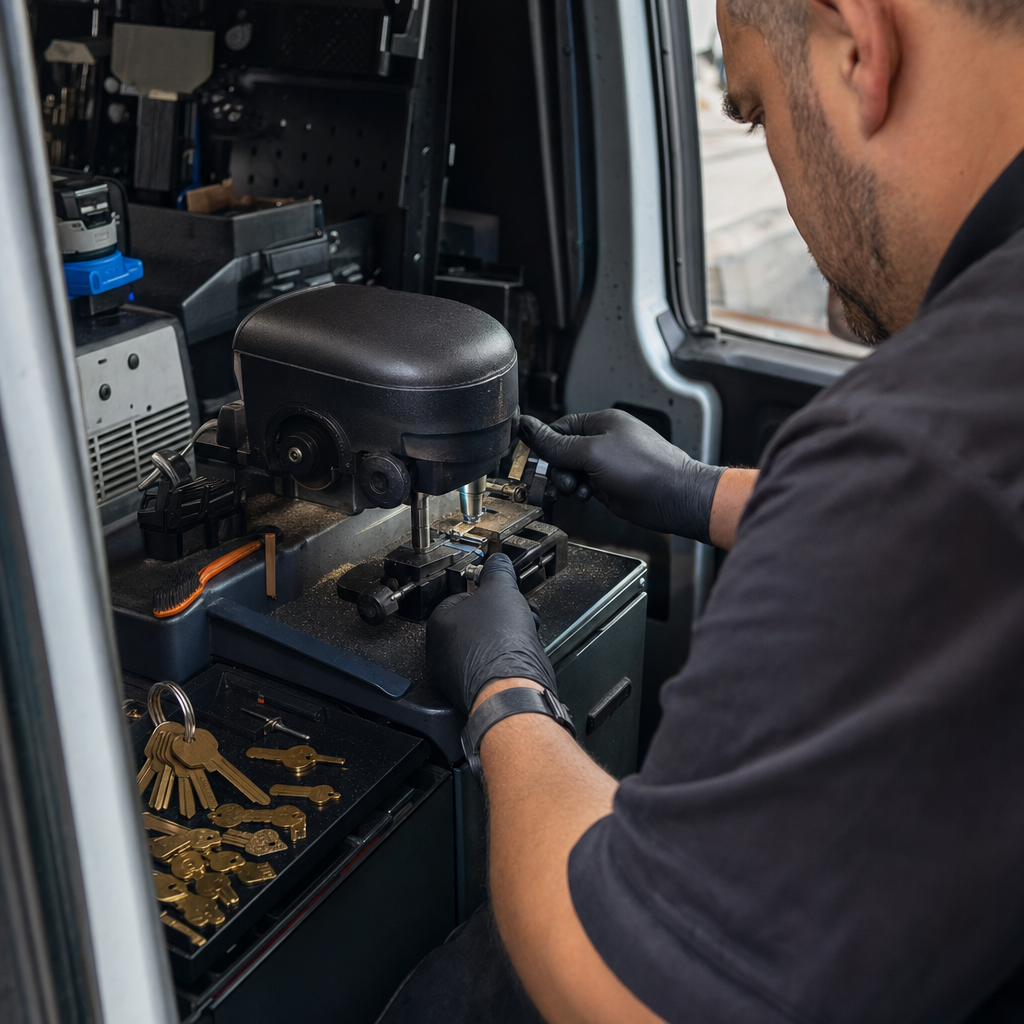
We cut replacement keys and program transponders for most vehicle makes. The process requires both a key cutting machine matched to the original bitting code and a programming device that communicates with the vehicle’s immobilizer. Automotive Locksmith in Los Angeles services from Strongbox Lock & Safe Co. include on-site cutting and programming, so you’re not towed to a dealer.
Worn Ignition Wafers vs. Failed Ignition Cylinder
This distinction matters because it determines whether you need a locksmith or a mechanic, and what the repair will cost.
Worn Ignition Wafers: The Progressive Problem
Inside the ignition cylinder, small spring-loaded wafers align with the key’s cuts. Over years of use, these wafers wear, their springs weaken, and debris accumulates. The symptoms develop gradually:
- The key becomes harder to insert, especially in cold mornings.
- You must jiggle the key slightly to find the turn position.
- The key works better in one direction than the other.
- The problem is intermittent, worse some days than others.
A locksmith can often repair this by disassembling the cylinder, replacing worn wafers, cleaning debris, and lubricating with graphite (never oil-based lubricants, which attract dust). In Los Angeles, where dust and Santa Ana winds introduce fine particulate, we see this more frequently than in humid climates where moisture keeps debris settled. Repair cost typically runs $150-$280.
Failed Ignition Cylinder: The Sudden Break
Cylinder failure is more dramatic. The symptoms include:
- The key inserts but spins freely without engaging positions.
- The key turns to Start but springs back to Run abnormally, or not at all.
- The key cannot be removed from the cylinder.
- The entire cylinder housing feels loose in the steering column.
This requires cylinder replacement. The locksmith removes the old cylinder, often by drilling a release pin in a specific location, installs a new cylinder keyed to match your existing key, and verifies proper operation of all positions: Lock, Accessory, Run, and Start. Replacement runs $200-$450 depending on vehicle complexity. Some European models require dealer-only parts; we source Medeco and Yale high-security equivalents where the owner wants upgraded protection. See our guide on choosing the right locksmith brand: a buyer’s guide for Los Angeles.
“Car Starts but Door Won’t Unlock” and “Key Turns but Nothing Happens”
These two symptom patterns confuse drivers because they seem contradictory. They point to entirely different failure modes.
Car Starts but Door Won’t Unlock
This indicates a separation between the immobilizer system and the door lock actuators. The transponder is recognized, so the engine runs. But the central locking system, which may use a different frequency or module, has failed.
Diagnostic path:
- Test all doors. If only one fails, the actuator in that door has failed. This is a mechanic’s repair, involving door panel removal.
- If all doors fail to respond to the fob but unlock with the physical key, the receiver module or body control module has a fault. Try the spare fob to rule out a single fob failure.
- If the fob LED lights but no doors respond, and the spare fob behaves identically, the vehicle’s receiver is likely at fault. Some Honda and Acura models of the 2010s are notorious for receiver module failure in hot climates like Los Angeles.
A locksmith can program new fobs and verify transponder function, but module replacement requires a mechanic or dealer. We will tell you which you need before any work begins.
Key Turns but Nothing Happens
This is the more serious pattern. The key rotates through all positions normally, but:
- No dashboard lights illuminate.
- No accessory functions operate (radio, windows).
- The starter does not engage.
- The engine does not start.
This usually indicates electrical failure, not a lock problem. Possible causes: failed ignition switch (electrical portion behind the cylinder), blown fuse, dead battery, or starter circuit fault. However, one lock-specific cause exists: if the cylinder has been replaced previously with an incorrect part, the mechanical linkage to the electrical switch may be misaligned. The key turns, but the switch never moves.
We check this alignment on every ignition service. It takes thirty seconds with the column covers removed, and it has saved many Los Angeles customers from unnecessary electrical diagnosis.
Warranty-Voiding Steps to Skip on Newer Vehicles
Newer vehicles, particularly 2020 and later, have sophisticated immobilizer and keyless entry systems with warranty terms that specifically exclude damage from non-dealer programming attempts. Before you attempt any troubleshooting, confirm your warranty status.
Steps That Can Void Warranty Coverage
- Aftermarket key programming: Some manufacturers, notably BMW and Mercedes, log programming events in the vehicle’s computer. An unauthorized programming attempt can flag the immobilizer module and void related warranty claims.
- Cylinder drilling or removal: Drilling a release pin on a warranty-covered vehicle, even by a professional, may be cited as “unauthorized modification” if done outside the dealer network.
- Jump-starting through the OBD port: Some online guides suggest powering the OBD port to force programming mode. This can damage sensitive modules and is universally excluded from warranty.
- Third-party “universal” fobs: Using non-OEM fobs that require adapter programming can corrupt the immobilizer data on some Ford and Nissan systems.
Safe approach: If your vehicle is under manufacturer warranty, call the dealer first for key and immobilizer issues. If they cannot accommodate you quickly, a licensed locksmith can perform many services without warranty impact, but you should document that the work was necessary due to dealer unavailability. We provide written invoices for this purpose. Strongbox Lock & Safe Co. home services include documentation that supports warranty claims, not undermines them.
Common Mistakes to Avoid
- Using WD-40 in any lock or ignition. It attracts dust and gums up over months. In Los Angeles, where dust is constant and summer heat accelerates evaporation, WD-40 turns into a sticky residue that requires complete disassembly to remove. Use graphite powder only.
- Repeatedly trying a resync procedure. As noted above, most vehicles limit programming attempts. Three failures often trigger a lockout. Stop after one precise attempt.
- Ignoring the spare key. Many drivers never test their spare until the primary fails. Test both keys quarterly. If the spare works when the primary doesn’t, you’ve isolated the problem to one key, not the vehicle.
- Buying uncut “blank” fobs online. These require both cutting and programming. The cutting must match your original bitting code; guessing by photo comparison never works. The programming requires equipment most consumers don’t own. The $15 fob becomes a $200 mistake.
- Assuming all locksmiths program all vehicles. Some 2022+ models require dealer-level tools. We maintain current programming capabilities for most makes, but we will tell you honestly if your vehicle requires dealer service. Residential Locksmith in Los Angeles and automotive services from Strongbox Lock & Safe Co. are backed by the 90-Day Done Right Promise, so if we take the job, we finish it.
- Overlooking the obvious. We’ve arrived at calls in Beverly Hills and Downtown LA where the “failed” fob simply had a button stuck under the key ring, transmitting constantly and draining the battery. Check the basics before escalating.
When to Call a Professional
Call a locksmith when you’ve completed the decision tree above and reached one of these points: the transponder needs resync and you’ve exhausted your single careful attempt; the ignition wafers are worn and the key binds or requires jiggling; the ignition cylinder has failed completely; you need a replacement key cut and programmed; or you’ve damaged a key and need extraction from a lock or ignition.
Call a mechanic, not a locksmith, when: the engine cranks but won’t start (fuel or ignition system); the starter engages but sounds abnormal (starter or flywheel); all electrical systems are dead regardless of key position (battery, alternator, or major electrical fault); or a single door actuator has failed while others work.
Strongbox Lock & Safe Co. offers free estimates in Los Angeles - call (877) 664-8139. We’ll ask the right questions over the phone, quote a flat price before any truck rolls, and send a background-checked, uniformed technician who shows ID at your door. If we can solve it with guidance over the phone, we’ll do that instead. We’ve served local communities for over 42 years, and we plan to be here when you need us again.
Frequently Asked Questions
Basic service calls in Los Angeles typically run $85-$150 for standard hours, with key cutting and programming adding $65-$200 depending on transponder complexity. Ignition cylinder repair or replacement ranges $150-$450. Strongbox Lock & Safe Co. quotes a flat price on the phone before any work begins, so the price you hear is the price on the invoice. Call (877) 664-8139 for an exact quote - estimates are free.
Some vehicles allow owner programming, typically requiring two existing working keys to authorize a third. If you only have one working key, or none, you need professional programming equipment. Attempting unauthorized programming on newer vehicles can lock the immobilizer module and trigger warranty exclusions. When in doubt, call for guidance before attempting.
The door lock and ignition cylinder use different wafer configurations. Over years, the ignition wafers wear more because they bear spring pressure and rotational force. A worn key may still align well enough for the simpler door mechanism while failing the tighter tolerances of the ignition. Alternatively, the ignition cylinder itself may have debris or damaged wafers. A locksmith can determine which within minutes.
If the key inserts and turns with normal mechanical resistance through all positions, but no electrical functions activate, the problem is likely the electrical switch behind the cylinder. If the key binds, sticks, or rotates abnormally, the cylinder is at fault. Some vehicles allow testing by gently wiggling the key in the Run position; if accessories flicker, the switch contacts are worn.
Yes. Dashboard temperatures in parked vehicles can exceed 160°F in summer. This accelerates battery drain, weakens solder joints on circuit boards, and can warp plastic key heads. We see more transponder chip failures in August than any other month. Store fobs in a bag or compartment, not exposed on the dash or console.
Dealerships typically charge $200-$600 for key replacement and may require towing the vehicle. A licensed automotive locksmith comes to your location, often same-day, with mobile cutting and programming equipment. For most vehicles 2015 and older, a locksmith provides equivalent quality at lower cost with faster response. For some 2022+ luxury models with encrypted key systems, the dealership may be the only option. We will tell you honestly which applies to your vehicle.
The Bottom Line
Start every automotive lock problem with the five-minute decision tree: battery, transponder, physical key, ignition wafers, ignition cylinder. For more guides & resources, explore our blog. Replace the battery yourself when it’s dead. Attempt one precise resync if the transponder has desynced. Inspect for visible key damage. Recognize worn wafers by gradual degradation and failed cylinders by sudden mechanical breakdown. Know which symptoms point to locksmith repair and which require a mechanic. Skip any step that might void a manufacturer warranty on a newer vehicle. When you need professional help, choose a licensed technician who quotes upfront, guarantees the work, and plans to be in your community for decades. That’s the standard we hold ourselves to at Strongbox Lock & Safe Co.
Need help diagnosing your automotive lock problem? Call (877) 664-8139 for a free estimate. A live person answers every call, 24/7, including nights, weekends, and holidays. We’ll quote a flat price before any truck rolls, and every job is backed by our 90-Day Done Right Promise in writing. Seniors and veterans receive a permanent 5% discount. We also offer $50 off any repair over $250, free second opinions on any written estimate, and an $89 seasonal tune-up.
Written by the team at Strongbox Lock & Safe Co., serving Los Angeles since 2013.