
Lock Won’t Turn
A lock that won’t turn is almost always caused by one of four things: a worn or damaged key, a dry or dirty lock cylinder, a misaligned bolt or latch, or an internal mechanism that has finally given out after years of use. In most cases, a trained locksmith can diagnose the problem at the door and fix it in a single visit. Don’t force it – forcing a stiff lock is the fastest way to turn a simple repair into a full replacement.
Most locks that refuse to turn aren’t broken beyond repair. They’re telling you something – usually that they’ve been neglected, or that a small part has worn down to the point where it can’t do its job anymore. The good news is that once you know what’s actually wrong, the fix is almost always straightforward. What follows will help you narrow it down before anyone shows up.
Why It Happens
The Key Is Worn or Wrong
Keys wear down over time, and a key that’s been cut dozens of times from the original gradually loses the precision it needs to lift the lock’s pins correctly. If your key goes in but won’t rotate – or rotates only partway – look at the teeth closely. Rounded, shiny edges where there should be crisp cuts are a giveaway. The same symptom shows up when someone grabs the wrong key and tries it too confidently in low light.
The Lock Cylinder Is Dry or Gummed Up
Lock cylinders need lubrication to work smoothly, and most of them go years without any. Over time, old lubricant turns into a paste that binds the pins in place, or the cylinder simply runs dry and corrosion sets in. You’ll notice this type of problem because the key turns a little – maybe a quarter rotation – and then stops cold, or it turns only under real pressure. This is the most common cause we see in locks that have been on a door for more than ten years without any service.
The Door or Frame Has Shifted
Houses settle. Door frames rack. When a door shifts even a small amount, the bolt or latch no longer lines up cleanly with the strike plate, and the lock cylinder has to fight the mechanical stress to complete its rotation. Look at the gap around your door: if it’s uneven, or if the door requires a lift or a shove to close properly, misalignment is likely your problem. You’ll often hear a scraping sound as the bolt tries to seat itself.
The Internal Mechanism Has Failed
Deadbolts and knob locks contain small springs, pins, and wafers that work thousands of times before wearing out – but they do wear out. When a spring breaks or a pin seizes internally, the key may turn freely without engaging the bolt, or the cylinder may refuse to move at all regardless of which key you use. This kind of failure usually comes on gradually: the lock gets stiffer over weeks, then one morning it just won’t go. If the lock is original to a house built before the mid-2000s, internal wear is a strong candidate.
What to Do Right Now
- Stop forcing it. If the key won’t turn with normal hand pressure, applying more force risks snapping the key in the cylinder or damaging the pins. A broken key inside the lock turns a simple repair into a more involved extraction job.
- Try a spare key. If you have an original key or a spare cut from the original, try that one. If it turns when the daily key doesn’t, the problem is the key – not the lock.
- Photograph the door gap and the strike plate area. This takes thirty seconds and gives the technician useful information before they even touch the lock – especially if the door has settled or the frame has shifted.
- Check whether the bolt is partially extended. Sometimes a deadbolt gets bumped into a halfway position. If you can see the bolt through the door edge and it isn’t fully retracted, that alone may be preventing rotation.
- Do not spray WD-40 into the cylinder. It’s a degreaser, not a lubricant, and it will strip whatever residual lubrication remains. If you have dry graphite or a purpose-made lock lubricant on hand, a small application in the keyway can help. If you don’t, leave it for the technician.
How We Fix It
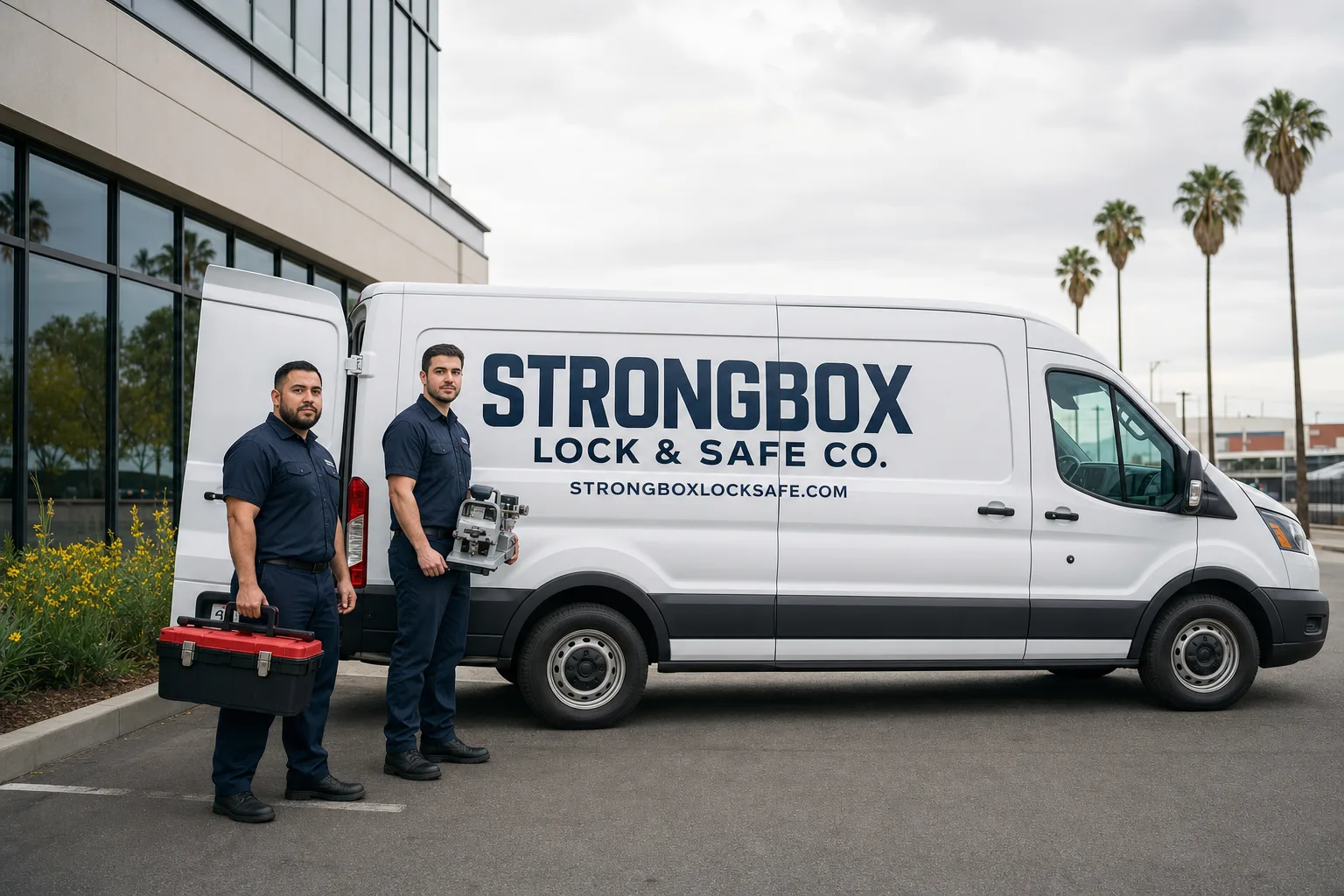
When your local Strongbox Lock & Safe Co. team arrives, the technician starts by testing the lock with your key, checking the door alignment, and inspecting the cylinder face for visible wear or damage. That first look – before any tools come out – usually tells us whether we’re dealing with a lubrication issue, a worn key, a misaligned strike, or a cylinder that needs to be replaced.
If it’s lubrication or minor binding, most cylinders respond to a proper cleaning and a correct-grade lubricant in under twenty minutes. If the cylinder is worn through, we carry Schlage, Kwikset, Baldwin, and Medeco hardware on the truck so the right lock goes on the right door that same visit. Door alignment problems are addressed at the strike plate first – that’s usually where the fix lives.
This work falls under our Lock Installation & Rekey service, and in cases where a key has broken inside the cylinder, it’s handled as an Emergency Locksmith call. Before we start anything, you’ll have the price in writing. That’s the number on the invoice – no adjustments, no surprises. Most jobs like this are done in a single visit, and every one is backed by our 90-Day Done Right Promise: if it’s not right, we come back. No paperwork. No arguing.
Frequently Asked Questions
It depends on where the lock is. A lock that turns stiffly but still works is not an emergency, but it is a warning – stiff locks fail completely without much notice, often at the worst possible time. A lock that won’t turn at all on an exterior door is a security and access problem that shouldn’t wait. Call (877) 664-8139 and let us help you decide how quickly you need someone out there.
Yes. Our phones are answered by a live person every hour of every day, including weekends and holidays – there’s no voicemail tree and no callback queue. Your local Strongbox Lock & Safe Co. team can schedule same-day service in most situations. Call (877) 664-8139 and we’ll tell you exactly when someone can be there.
Repair is usually less expensive when the cylinder is the only problem – a cleaning, a rekey, or a new cylinder core costs less than a full lockset. Replacement makes more sense when the hardware itself is old enough that the next failure is likely within a year or two anyway, or when you’re upgrading to higher-security hardware like Medeco or Mul-T-Lock at the same time. We’ll give you both options in writing before anything starts, so you can make the call with real numbers in front of you.
Stop inserting anything into the keyway – probing with a pin or a paperclip usually pushes the broken piece deeper. Broken key extraction is a standard service and doesn’t always require replacing the lock. The cylinder may come through intact and be re-usable once the fragment is out. Call (877) 664-8139; this is one of the more common calls we get, and it’s handled cleanly in most cases during the first visit.
Get It Fixed
Call (877) 664-8139 – a live person answers every hour of every day. Your local Strongbox Lock & Safe Co. team will give you an upfront price in writing before work begins, show up in uniform with ID, and back the job with our 90-Day Done Right Promise. Most lock problems are resolved in a single visit.
Written by Gil Navarro, Owner at Strongbox Lock & Safe Co., proudly serving local communities since 1984.