
Deadbolt Won’t Line Up With the Frame
What’s Happening
A deadbolt that won’t line up with the strike plate is almost always caused by door sag, frame movement, or seasonal wood expansion – meaning the door itself has shifted, not that the lock is broken. The bolt is going to the same place it always has; the hole it’s supposed to enter has moved.
That distinction matters because it changes what needs to be fixed. Replacing the lock won’t solve a geometry problem. What you’re dealing with is a door that has moved relative to its frame – sometimes by as little as an eighth of an inch – enough to put the bolt and the strike plate out of alignment. It happens gradually, so most homeowners don’t notice until one day the bolt just won’t throw all the way home, or it throws but then grinds when you try to retract it. Sometimes the door has always done this a little, and now it’s doing it a lot. The underlying cause is what determines the right fix.
Why It Happens
Door Sag from Loose or Worn Hinges
This is the most common cause by a wide margin. Over years of use, hinge screws work loose from their holes, and when they do, the door drops slightly at the latch side. Even a small drop is enough to put the bolt a quarter inch below the strike plate opening. You can check for this without any tools: stand back and look at the gap around the door. If the gap at the top latch-side corner is noticeably wider than at the bottom, the door is sagging. Try lifting the door handle firmly while you throw the bolt – if it lines up when you lift, a hinge is the source of your problem.
Seasonal Wood Movement
Wood doors and wood frames absorb moisture and expand in humid months, then dry out and contract in winter. A door that locks fine in January might fight you every August. If the misalignment comes and goes with the seasons – or you’ve noticed it getting worse since a stretch of rainy weather – wood movement is the likely explanation. Look at the door’s edge when it’s closed: if it’s pressing noticeably harder against the stop molding on one side, the frame or door has swollen.
Foundation or Structural Settling
Houses move. Foundations settle unevenly over decades, and that movement telegraphs right up into door frames. This type of misalignment tends to be more severe and doesn’t fluctuate with the seasons – it just gets progressively worse over time. A door that’s started sticking along its entire length (not just at the bolt) or has visible gaps at one corner of the frame while the opposite corner binds is showing signs of frame racking from settling. A locksmith can confirm the alignment problem and fix the lock side of it; if the frame movement looks significant, a contractor conversation may also be warranted.
Strike Plate That’s Shifted or Was Never Positioned Correctly
Strike plates are set with screws, and those screws can strip out of soft framing wood over years of use, letting the plate shift slightly up, down, or inward. Less commonly, the plate was installed off-center to begin with and has been marginal ever since. To check this, look closely at the bolt when you throw it partially. Is it catching the edge of the strike plate opening rather than entering cleanly? Is there a worn scratch mark on the plate where the bolt is hitting the rim? Those are signs the plate is the problem, not the frame.
What to Do Right Now
- Stop forcing the bolt. Repeatedly driving a misaligned bolt against the strike plate edge bends the bolt, damages the strike plate, and can crack the door frame around the plate. If it doesn’t throw freely, don’t force it.
- Check whether you can still secure the door. If the bolt won’t fully engage, your door is not locked – even if it looks closed. Use a secondary lock or chain until this is repaired. A door that won’t fully deadbolt is a real security gap.
- Try the lift test. Grip the door handle and apply gentle upward pressure while throwing the bolt. If it aligns when you lift, the problem is almost certainly a sagging hinge, and that information is useful for whoever comes to fix it.
- Photograph the gap. Take a clear photo of the door gap from outside, a close-up of the bolt against the strike plate, and a shot of the hinge side of the door. This takes two minutes and gives your technician a head start before they arrive.
- Check the hinges visually. Look at each hinge while someone else slowly opens and closes the door. If you see any wobble, if the screws look stripped, or if one hinge sits proud of the door while another sits flush, note which hinge it is.
How We Fix It
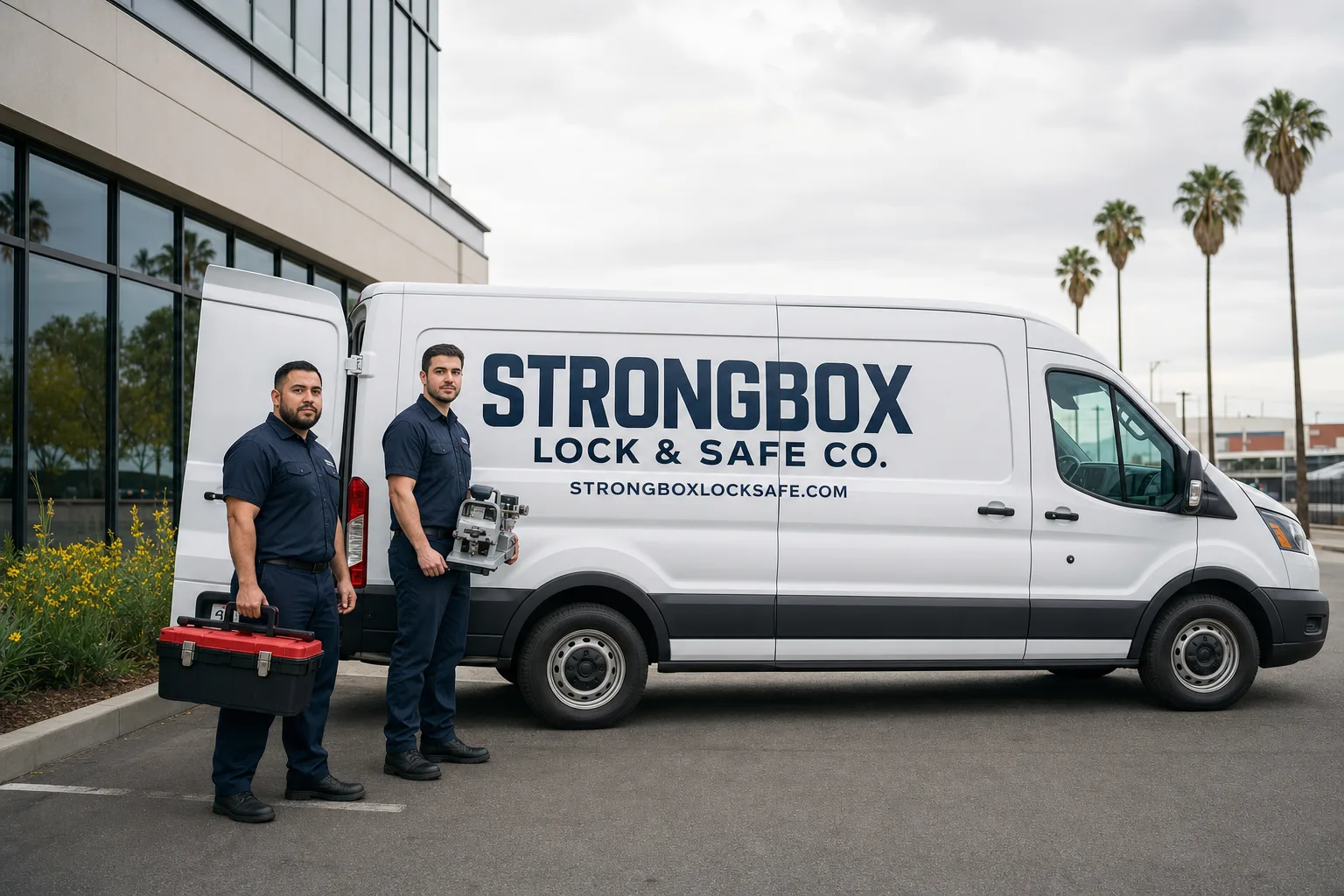
When your local Strongbox Lock & Safe Co. team arrives, the first thing the technician does is assess the full geometry – door, frame, hinge alignment, and strike plate position – before touching anything. Diagnosing the cause correctly is what prevents the same problem from coming back in six months.
If sagging hinges are the culprit, we reset them using longer structural screws that anchor into the wall framing behind the jamb, not just the jamb itself. That’s a fix that holds. If the strike plate needs repositioning, we move it to where the bolt actually travels, mortise it flush, and fill the old void so the door frame stays solid. In cases where the door has shifted enough that the strike plate relocation alone won’t do it, we may also adjust the door stop.
This work falls under our Lock Installation & Rekey and Residential Locksmith services. Most jobs like this are done in a single visit. Before any work starts, you get a written price – what it costs, in writing, on the phone – with no surprises on the bill. Every job is backed by the 90-Day Done Right Promise: if it’s not right, we come back. No paperwork, no arguing.
Frequently Asked Questions
Yes, if the bolt won’t fully engage, the door is effectively unlocked regardless of how it looks. A deadbolt that only catches the edge of the strike plate, or doesn’t throw all the way, provides almost no resistance to forced entry. Don’t leave it overnight or over a weekend thinking it’s close enough – use a secondary lock in the meantime and call (877) 664-8139 to get someone out as soon as possible.
Filing or enlarging the strike plate opening is a short-term workaround, not a fix. It weakens the plate’s ability to resist kick-in force, and it doesn’t address why the bolt is misaligned in the first place. If the door continues to shift – which it will if a hinge or structural issue is driving it – you’ll be filing again in a year, and the plate will eventually be too compromised to do its job. The right fix addresses the cause.
Most deadbolt alignment jobs are handled in a single visit, often within an hour, once the technician has diagnosed the root cause. Hinge resets and strike plate repositioning are straightforward work when done properly. If there’s a more complex frame issue at play, the technician will tell you that on-site and explain what’s involved before any additional work proceeds.
Call us at (877) 664-8139 and a live person will answer – day or night, weekends and holidays included. Your local Strongbox Lock & Safe Co. team handles same-day service for situations exactly like this one. We’ll give you an upfront price on the call and tell you when to expect us. No voicemail, no callback queue.
Get It Fixed
Call (877) 664-8139 – a live person answers around the clock – or book online. Your local Strongbox Lock & Safe Co. team will diagnose the misalignment, give you a written price before anything starts, and back the work with our 90-Day Done Right Promise.
Written by Gil Navarro, Owner at Strongbox Lock & Safe Co., serving local communities since 1984.