
Last updated July 25, 2026
Lock Installation & Rekey Troubleshooting: Common Problems and How to Fix Them
A lock that binds slightly on the first day after installation isn’t breaking in - it’s telling you the strike plate is misaligned by as little as 1/16 of an inch. That is a five-minute fix with a screwdriver and a marker, yet most homeowners in Los Angeles call a locksmith back for it unnecessarily. Over 42 years of opening doors across this city, we’ve learned that the majority of post-installation callbacks aren’t defects at all. They’re installation errors that reveal themselves within 48 hours, and they follow a pattern. This guide walks you through the four symptoms to watch for, which ones you can fix yourself, and which ones mean the cylinder is backing out and needs professional attention.
Quick Answer
After Lock Installation & Rekey services, four symptoms indicate common installation errors rather than defective hardware: a binding key, stiff deadbolt throw, door latch not catching, or key turning with no bolt movement. Most strike plate misalignments can be corrected by homeowners with a screwdriver and marker. A key that feels increasingly tight after two weeks usually signals a cylinder backing out and requires a technician. Issues appearing within 48 hours that don’t worsen are typically normal settling; any problem that escalates after installation should be addressed under labor warranty.
Table of Contents
- The Four Post-Installation Symptoms and What They Mean
- How to Check and Adjust Strike Plate Alignment
- New Key Feels Tight vs. Worn Key Feels Loose: What’s Normal
- When a Rekeyed Lock Gets Harder to Turn After Two Weeks
- What Voids a Labor Warranty vs. Normal Settling
- Brand-Specific Quirks: Medeco, Yale, Baldwin, and Mul-T-Lock
- Common Mistakes to Avoid
- When to Call a Professional
- Frequently Asked Questions
The Four Post-Installation Symptoms and What They Mean
Every callback we’ve handled in Los Angeles neighborhoods from Sherman Oaks to San Pedro follows one of four patterns. Learning to read these symptoms saves you a service call and tells you whether you’re looking at a two-minute adjustment or a return visit.
Symptom 1: The Binding Key
You insert the key and it catches, requires jiggling, or won’t slide in smoothly. In our experience, this is the strike plate 70% of the time. The bolt or latch is scraping against the strike’s metal edge instead of gliding into the pocket. The other 30% splits between a poorly deburred key cut and, less commonly, a pin stack that wasn’t fully compressed during rekeying.
Test it: With the door open, does the key operate smoothly? If yes, it’s alignment. If no, it’s the key or cylinder.
Symptom 2: Stiff Deadbolt Throw
The thumb turn or key requires noticeable force to extend or retract the bolt. This often traces to over-tightened mounting screws that are pinching the bolt housing, or paint buildup inside the bore hole. In older Los Angeles homes with multiple paint layers - common in 1920s bungalows in Highland Park or Echo Park - the bolt channel narrows fractionally with each repaint.
Symptom 3: Door Latch Not Catching
You close the door and it doesn’t stay shut, or the latch clicks but releases with light pressure. This is almost always vertical misalignment: the strike plate sits too high or low relative to the latch. Seasonal humidity shifts in Los Angeles, particularly in canyon-adjacent areas like Laurel Canyon or Topanga, cause wood doors to swell or contract enough to create this gap.
Symptom 4: Key Turns, Bolt Doesn’t Move
This is the only symptom we classify as urgent. The tailpiece connecting the cylinder to the bolt mechanism has slipped, broken, or was never fully engaged. The lock is functionally bypassed. Do not rely on it for security. This requires immediate reinstallation or repair.
How to Check and Adjust Strike Plate Alignment
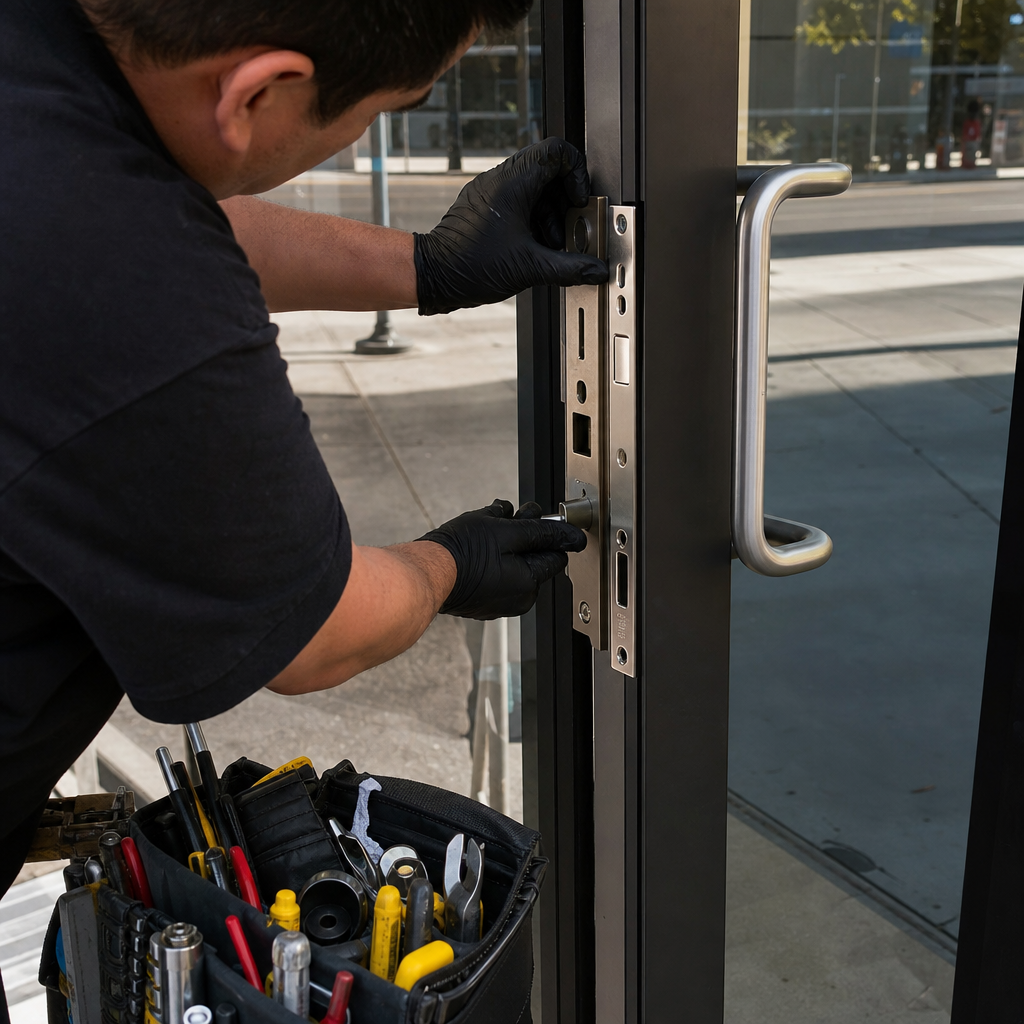
This is the fix that eliminates most unnecessary callbacks. You need a Phillips screwdriver, a flathead screwdriver, a permanent marker, and five minutes.
- Open the door fully. Turn the deadbolt or latch so it extends.
- Close the door slowly while watching where the bolt meets the jamb. Look for the contact point.
- Mark the jamb with your pen where the bolt tip touches. This shows you exactly where the strike pocket should be.
- Remove the strike plate screws with your Phillips screwdriver. Save them.
- Compare your mark to the existing strike pocket. If it’s off by 1/8 inch or less, enlarge the pocket with the flathead screwdriver by scraping the edge toward your mark. For larger misalignments, you’ll need to reposition the strike plate and drill new pilot holes.
- Reinstall the strike plate. Test operation ten times before considering it fixed.
The key detail competitors miss: most strikes are installed with screws that bite only into the door jamb’s surface wood. In Los Angeles, where many homes have soft pine jambs and frequent seismic settling, these screws loosen. We always install strikes with 3-inch screws that reach the structural framing behind the jamb. If your original installer didn’t, this is your opportunity to upgrade.
When this fix doesn’t work: If the bolt still binds after strike adjustment, check whether the door itself is sagging. Open the door to 90 degrees and lift the handle. If the door moves upward, the hinges are loose or the pin is worn. Tighten hinge screws or replace the pin before adjusting the lock hardware further.
New Key Feels Tight vs. Worn Key Feels Loose: What’s Normal
After a rekey, homeowners often call us with the same question: “Should the new key feel this tight?” The answer depends on what you’re comparing it to.
A worn key that you’ve used for years feels loose because the peaks have flattened and the valleys have widened. The key no longer precisely lifts each pin to the shear line; it sort of shoves them there. A new key, cut to factory specifications with sharp edges, engages each pin stack cleanly. That precision feels like resistance if you’ve grown accustomed to slop.
Normal tightness: The key inserts fully with steady pressure, turns smoothly once seated, and improves slightly over the first week as microscopic burrs wear off.
Abnormal tightness: The key requires rocking or wiggling to insert, catches at a specific depth, or feels gritty. These indicate a pin stack error - a pin too long, a spring compressed incorrectly, or debris in the cylinder. In our Los Angeles shop, we see this most often after DIY rekey kits or when a previous locksmith reused old pins from a different manufacturer’s keyway.
One specific Los Angeles factor: coastal moisture in neighborhoods like Venice, Playa del Rey, and San Pedro can accelerate corrosion inside cylinders that weren’t properly lubricated after rekeying. If your tight key also feels gritty or produces dark residue on your fingers, the cylinder needs cleaning and lubrication with a graphite-based product, not WD-40.
When a Rekeyed Lock Gets Harder to Turn After Two Weeks
This is the symptom that fools everyone, including some locksmiths. The key worked fine at first. Now, two weeks later, you’re using more force. The natural assumption is wear, or that something broke. Usually, it’s the cylinder slowly backing out of the housing.
Here’s what happens: during rekeying, the cylinder is removed, the pin stacks are changed, and the cylinder is reinserted. The retaining clip or set screw that holds it in place must be tightened to a specific torque. Too loose, and vibration from daily use - plus the thermal expansion and contraction that Los Angeles doors experience between 55-degree winter mornings and 85-degree afternoons - allows the cylinder to migrate outward by fractions of an inch.
As the cylinder backs out, the tailpiece angle changes. What was a straight push becomes a slight lever action. The mechanism binds. The key feels harder to turn.
Check it yourself: Look at the cylinder face. Is it flush with the escutcheon, or does it protrude slightly? Does pushing the cylinder inward with your thumb while turning the key make operation easier? If yes, the retaining hardware needs tightening. This is a five-minute fix with the right tools, but the cylinder must be positioned precisely or you’ll create new problems. We recommend calling for this one - it’s covered under our Strongbox Lock & Safe Co. home 90-Day Done Right Promise if we performed the original rekey.
What Voids a Labor Warranty vs. Normal Settling
Every reputable locksmith in Los Angeles offers some form of labor warranty. Understanding where the line falls between “settling” and “defect” saves you from paying for a fix that should be free, and from expecting coverage for something that isn’t a workmanship issue.
Normal settling (not a warranty issue):
- Strike plate adjustment needed after 30-60 days of seasonal door movement
- Slight key loosening as factory edges wear to your specific turning pattern
- Latch requiring firmer push in high humidity when wood expands
- Screw loosening from vibration, provided original installation torque was correct
Workmanship defects (covered under labor warranty):
- Cylinder backing out due to improper retaining clip torque
- Pin stack errors causing binding or master key system failures
- Deadbolt misalignment with the bore hole causing chronic stiff operation
- Tailpiece incorrectly cut or oriented, leading to “key turns, nothing moves”
- Installation of incorrect backset or faceplate size
At Residential Locksmith in Los Angeles, our 90-Day Done Right Promise covers the workmanship defects above with no paperwork and no arguing. If it’s not right, we come back. Normal settling adjustments after the first 60 days carry a nominal service fee, though our senior and veteran customers receive their permanent 5% discount on these calls as well.
What voids any locksmith’s labor warranty: drilling, filing, or disassembling the hardware yourself; using liquid lubricants that gum the pin stacks; or allowing another technician to alter the installation. Document what you observe, call the original installer, and let them assess it.
Brand-Specific Quirks: Medeco, Yale, Baldwin, and Mul-T-Lock
High-security locks behave differently than standard residential hardware after installation. These are the post-installation quirks we’ve documented across thousands of Los Angeles installations.
Medeco: The sidebar mechanism requires precise vertical and horizontal key positioning. New Medeco keys feel notably stiffer than Kwikset or Schlage equivalents for the first two weeks. This is normal. What isn’t normal: a clicking or grinding sensation, which indicates a sidebar spring installed incorrectly. Medeco cylinders also demand specific keyway lubrication - graphite only, never petroleum-based products.
Yale: Their rim cylinder tailpieces come in multiple lengths. An installer who grabs the wrong one from the truck will have a cylinder that seems secure but develops play after 50-100 operations. In commercial applications around downtown Los Angeles, where Yale is common on historic buildings, we’ve seen this manifest as a key that works in the morning but not by evening.
Baldwin: Premium hardware with tight tolerances. Baldwin deadbolts bind noticeably if the door bore isn’t perfectly perpendicular. Many Los Angeles contractors who install doors aren’t locksmiths; they drill freehand, and the slight angle doesn’t show until a precision Baldwin mechanism is fitted. The fix is a door bore correction, not a lock replacement.
Mul-T-Lock: The telescoping pin design makes rekeying unforgiving. A pin seated 1/64 inch too shallow will function initially but fail as the spring fatigues. Mul-T-Lock also uses proprietary key blanks that must be cut on specific machines - a generic key copy will insert but not operate, and may damage the cylinder. We see this frequently after homeowners take their Mul-T-Lock keys to hardware store kiosks in Los Angeles strip malls.
Common Mistakes to Avoid
- Assuming a binding lock needs “breaking in.” Locks don’t break in like leather shoes. Binding on day one means misalignment or a pin stack error. Waiting makes it worse.
- Using WD-40 on any lock cylinder. It attracts dust and gums the mechanism. In Los Angeles, where Santa Ana winds carry fine particulate, this accelerates failure. Use graphite or a Teflon-based dry lubricant.
- Ignoring seasonal door movement. A lock that worked in January but sticks in July isn’t defective. The door has swollen. Adjust the strike before calling for service.
- Accepting a rekey without testing all keys on site. Every key in the set should operate the lock smoothly before the technician leaves. One weak cut in a set of four means a return trip.
- Drilling a larger bore hole to “fix” a stiff deadbolt. This destroys the door’s structural integrity and voids every warranty. The deadbolt channel needs cleaning or the mounting screws need loosening, not a bigger hole.
- Hiring based on a $19 service call advertisement. These operators quote low, charge inflated “parts” fees, and install hardware that fails within months. In Los Angeles, the Commercial Locksmith in Los Angeles market sees this frequently with businesses who then need full replacement.
- Discarding old keys before confirming new ones work everywhere. Rekeying often involves multiple doors. Test every lock with every new key before disposing of the old set.
When to Call a Professional
Some situations aren’t worth troubleshooting yourself. Call a technician when the cylinder is backing out, when the tailpiece has slipped and the bolt doesn’t move, when you’ve attempted strike adjustment and the problem persists, or when you’re dealing with high-security hardware whose warranty requires certified installation.
Also call when security is compromised: a lock that doesn’t fully engage, a key that works in your neighbor’s lock (indicating a master key system error), or any situation where you cannot verify who has working keys.
Strongbox Lock & Safe Co. offers free estimates in Los Angeles - call (877) 664-8139. Our background-checked, uniformed technicians show ID at the door, quote a flat price before any work begins, and back every job with our written 90-Day Done Right Promise. We’ve served this community for over 42 years, and we plan to be here when you need us again in thirty more.
Frequently Asked Questions
If Strongbox performed the original work, adjustments within 90 days are covered under our Done Right Promise at no charge. For work performed by others, our diagnostic service includes a flat-price quote before we begin - no bait-and-switch, no surprises. Call (877) 664-8139 for a free estimate.
Your old key was worn and loose, which felt easier. The new key’s precise factory cuts engage the pin stacks correctly, which feels like more resistance. If the new key requires rocking, wiggling, or excessive force, that’s a pin stack error and needs correction.
Yes, strike plate adjustment is normal homeowner maintenance and doesn’t void labor warranties. Use the screwdriver-and-marker method described above. If adjustment doesn’t resolve the issue, call the original installer before attempting more invasive fixes.
Standard residential locks feel normal within one week of daily use. High-security brands like Medeco or Mul-T-Lock may take two weeks. If operation worsens after initially improving, that’s a red flag for cylinder backing out or pin stack failure.
Los Angeles follows California Building Code Chapter 10 for egress requirements. Single-family homes need no key to exit from the interior. Multi-family and commercial buildings have specific hardware requirements that vary by occupancy type. We handle code compliance on every Automotive Locksmith in Los Angeles and residential installation - it’s part of quoting the right hardware for the right door.
Strike plate adjustments and screw tightening are quick, inexpensive fixes. Cylinder reseating or pin stack correction takes more time but still costs less than full replacement. If the bore hole was drilled incorrectly or the wrong backset was installed, replacement of the door prep may be necessary. We offer a free second opinion on any written estimate you’ve received elsewhere.
The Bottom Line
The four symptoms - binding key, stiff deadbolt, latch not catching, and key turning without bolt movement - tell you whether you’re looking at a five-minute strike adjustment or a workmanship issue requiring professional correction. For additional help, explore our more guides & resources. Check strike alignment first. Distinguish normal new-key tightness from abnormal pin stack binding. Watch for the two-week degradation pattern that signals cylinder backing out. Know what’s covered under warranty and what isn’t. Most importantly, document what you observe and when it started. That information gets you faster, more accurate service when you do call.
Written by the team at Strongbox Lock & Safe Co., serving Los Angeles since 2013.