
Last updated July 25, 2026
How Long Does Commercial Locksmith Take? Timelines and What to Expect
A commercial rekey that should take 90 minutes routinely stretches to half a day - not because the locksmith is slow, but because nobody could locate the master key schedule or the facilities manager was off-site. In 42 years of serving Los Angeles businesses through our Commercial Locksmith services, we’ve learned that preparation determines timeline more than any tool in our van. This guide breaks down realistic wait and work times for every common commercial job, and more importantly, shows what your building needs to have ready before we arrive so the clock stops where it should.
Quick Answer
Most commercial locksmith jobs in Los Angeles take 20 minutes to 4 hours of actual labor, as detailed in How Long Does Lock Installation & Rekey Take? Timelines and What to Expect, but total project time often doubles due to information delays, access coordination, and security verification. A simple lockout resolves in 15-30 minutes; a full master key system for a mid-size building requires 1-2 days of scheduled work plus advance preparation.
Table of Contents
- Commercial Lockout Response: Same-Day Reality
- Rekeying Timelines: The Hidden Preparation Gap
- Master Key Systems: Multi-Day Projects Explained
- Access Control Installation: Hardware and Wiring Time
- Why After-Hours Calls Take Longer
- The Multi-Tenant Scheduling Layer
- Los Angeles District Timing: Downtown vs. Valley vs. Westside
- The Preparation Checklist That Cuts Billable Hours
Commercial Lockout Response: Same-Day Reality
A commercial lockout is the most time-sensitive call we handle. The actual work - picking, bypassing, or drilling and replacing a lock - takes 15 to 45 minutes in nearly every case. But the total time from your call to walking back through your door depends on factors most business owners don’t anticipate, which we cover in How Long Does Emergency Locksmith Take? Timelines and What to Expect.
During standard business hours in Los Angeles, our response time to commercial districts like Downtown, Culver City, or the Burbank media corridor averages 30-50 minutes. The San Fernando Valley and South Bay industrial parks add 10-20 minutes due to freeway dependence. After 6 p.m. or before 8 a.m., that window extends because we verify caller authority against property records before dispatch - a security step that protects tenants and landlords but adds 15-30 minutes to arrival.
Here’s what stretches a 20-minute job into a 3-hour ordeal:
- Unclear property ownership. We need to confirm you’re authorized to access the space. A business card and government ID help, but a lease or property management agreement speeds this dramatically.
- Unknown lock type. Is it a standard Schlage commercial deadbolt, a Medeco high-security cylinder, or an Abloy Protec2 system? Each requires different tools and techniques. A photo texted ahead saves a trip back to the shop.
- After-hours building access. Many Los Angeles commercial buildings, especially in Downtown and Koreatown, have security desks that close at 6 p.m. If the guard isn’t expecting us, we wait.
- Multiple failed keys or combinations. When every employee has tried their key and jammed the cylinder, extraction adds time.
The flat price we quote on the phone covers the work, not the waiting. Preparation is what keeps your invoice predictable.
Rekeying Timelines: The Hidden Preparation Gap
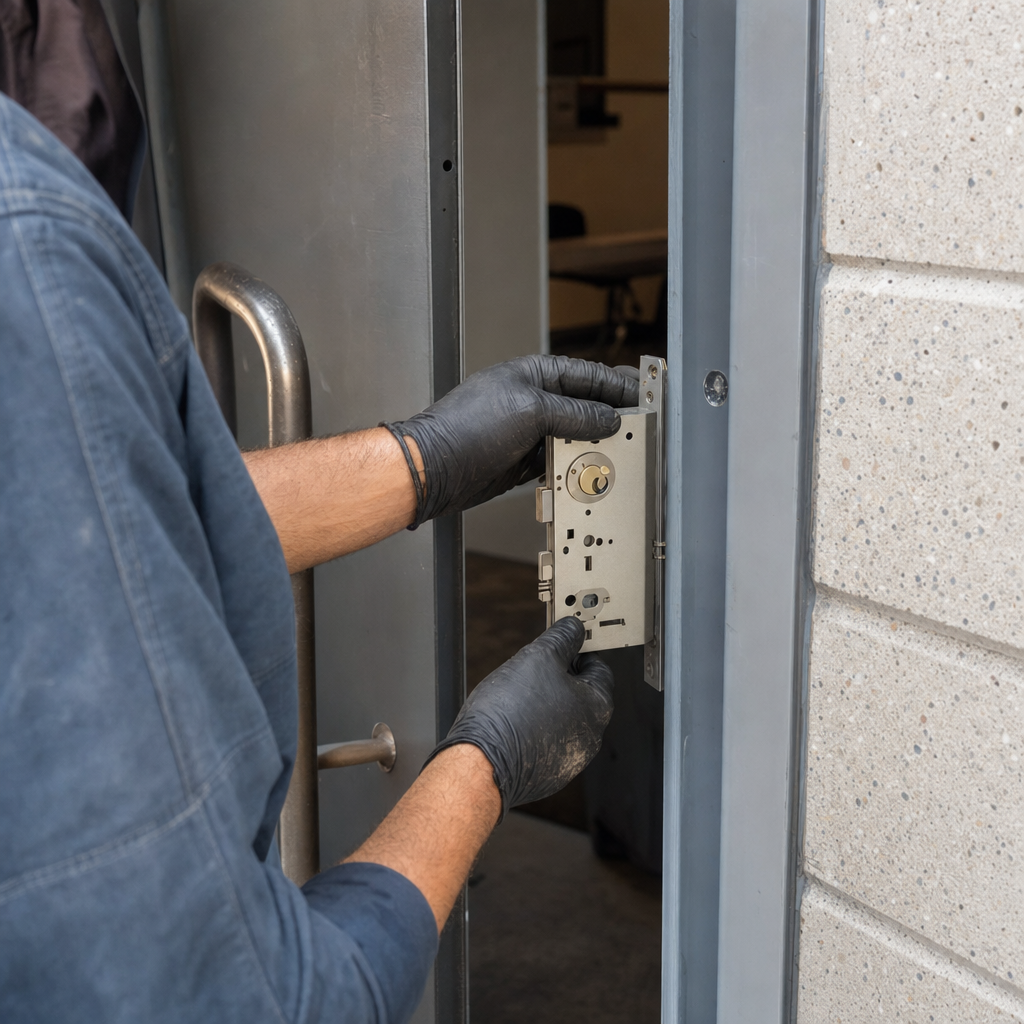
Rekeying - changing the internal pins so old keys no longer work - is straightforward locksmith work. A single commercial grade 2 lock takes 10-15 minutes to disassemble, repin, and reassemble. Multiply by your door count, add travel between suites, and you’ve got your labor estimate. Except you don’t, because most rekey delays have nothing to do with locks.
We completed a rekey last month for a 12-office professional building on Wilshire Boulevard. The physical work: 2.5 hours. The total billable time: 5.75 hours. The difference? The property manager had changed firms six months prior, and nobody had the current master key schedule. We spent 90 minutes with a maintenance supervisor testing keys to determine which cylinders belonged to which master level before we could begin.
A prepared rekey in Los Angeles typically runs:
- Small office (1-3 doors): 30-60 minutes on-site
- Retail storefront with storage: 45-90 minutes
- Professional suite (5-10 doors): 2-3 hours
- Multi-suite commercial building: 4-8 hours, often split across two days
The preparation that prevents delay:
- Locate your current master key schedule or hierarchy chart
- Confirm which employees or tenants need new keys, and how many copies each
- Decide whether you’re changing the master, sub-masters, or only individual keys
- Ensure access to all suites, including any currently vacant or sublet
- Have a facilities contact available by phone during the work window
We quote rekeying flat by the cylinder count once we know the scope. The price we quote is the price you pay - but the scope depends on what you can tell us before the truck rolls.
Master Key Systems: Multi-Day Projects Explained
Designing and implementing a master key system for a Los Angeles commercial property is not a same-day service. It is a planning project with installation phases. Understanding this timeline prevents the frustration of expecting immediate results from a complex security architecture.
Phase one is design: 2-5 business days. We audit every door, document current hardware brands and grades, and build a key hierarchy that matches your organizational structure. A medical office in Pasadena needed separate access levels for physicians, nursing staff, administrative personnel, and after-hours cleaning - four tiers across 23 doors. The design phase took four days of back-and-forth to get right.
Phase two is pinning and key production: 3-7 business days. Each cylinder is hand-pinned to its specific combination in our shop. For high-security systems like Medeco or Abloy, keys are cut to factory specifications and often require manufacturer authorization, which adds 2-3 days.
Phase three is installation: 1-3 days on-site, depending on door count and whether existing hardware must be upgraded to accept master pinning. Many Los Angeles buildings constructed before 1990 have residential-grade Kwikset or early Schlage hardware that cannot support a commercial master system without replacement.
Total realistic timeline: 1-2 weeks from initial consultation to final key handoff. Rush scheduling is possible for an additional fee, but we won’t compromise the design phase - a poorly planned master system costs more to fix than to build correctly the first time. Our 90-Day Done Right Promise covers master systems fully: if a key opens a door it shouldn’t, or a door resists a key that should work, we return without paperwork or argument.
Access Control Installation: Hardware and Wiring Time
Electronic access control - keycard readers, biometric units, PIN pads, and the controllers that manage them - represents the longest standard commercial locksmith timeline. These are construction-adjacent installations, not maintenance visits, and they interact with your building’s electrical, network, and fire safety systems.
A single-door standalone keypad lock: 1-2 hours. This is essentially a hardware swap with programming.
A networked four-door system with central management software: 2-4 days. This includes running low-voltage cable (or verifying Power over Ethernet infrastructure), mounting readers and electric strikes or magnetic locks, installing request-to-exit sensors, connecting to your network, configuring software, enrolling credentials, and testing every failure mode - power loss, fire alarm trigger, forced entry, tailgating.
Los Angeles adds specific considerations that extend timelines:
- Seismic bracing requirements. Magnetic locks over 1,000 lbs. holding force require additional mounting reinforcement per city amendments to the California Building Code. We inspect and specify this during our free estimate.
- Historic building restrictions. Properties in designated zones like the Broadway Theater District or certain Pasadena corridors may require visible hardware modifications to undergo review. We coordinate this but cannot control approval timing.
- Parking structure access. Many Downtown and Mid-Wilshire buildings have vehicle gates with loop detectors and intercoms. These integrate with pedestrian access control but require separate electrical coordination.
We install and service Schlage, Medeco, and other premium access control lines. The right hardware for your door, not just what fits our van. A square deal: the price we quote includes all labor, programming, and user training - no surprise line items when the invoice arrives.
Why After-Hours Calls Take Longer
Commercial locksmith work outside standard business hours costs more and takes longer. This is not markup for markup’s sake. It is the necessary cost of operating securely in a low-visibility environment.
Security verification intensifies after hours. During the day, we can confirm your identity against business registration, call a listed property manager, or verify with building security. At 11 p.m., those channels narrow. We require additional documentation - a business license, articles of incorporation, or direct callback to a number listed on public records - before dispatch. This adds 15-40 minutes to response time but prevents unauthorized entry that could expose us and you to liability.
Building access becomes uncertain. Many Los Angeles commercial properties, particularly in dense districts like Downtown, Hollywood, and Santa Monica, have automated parking systems and locked lobby doors after hours. If you cannot meet us at a designated entrance, we may need to coordinate with a remote security desk, adding unpredictable delay.
Hardware availability contracts. Our vans carry extensive inventory, but specialty cylinders for brands like Abloy or older Medeco systems may require a shop visit. During business hours, a runner can fetch these while we work. After hours, that option disappears, and we may need to install temporary hardware and return.
We answer every call with a live person, 24/7, including nights, weekends, and holidays. No voicemail trees, no callback queues. But we are transparent about after-hours realities: the job takes longer because the safeguards are stricter, and the price reflects that operational complexity.
The Multi-Tenant Scheduling Layer
Single-tenant commercial buildings operate on one timeline: yours. Multi-tenant buildings operate on several, and the locksmith is rarely the bottleneck.
We recently rekeyed a six-tenant medical building in Encino. The actual locksmith work occupied six hours across two days. The scheduling coordination consumed three weeks. Each tenant had different insurance requirements for notice periods. Two sublet their space and needed landlord approval to modify locks. One was a dialysis center with strict patient-hour restrictions. The property management company required 48-hour notice to building security for any after-hours work.
This is normal, not exceptional. In Los Angeles, where commercial lease structures vary enormously - gross, modified gross, NNN, sublease, management agreement - the entity with authority to authorize lock work is not always obvious.
To prevent the multi-tenant scheduling trap:
- Identify the single point of authorization before calling for estimates
- Confirm whether tenant notification is required, and who provides it
- Determine if any tenant has restricted hours (medical, religious, educational)
- Ask whether building engineering or security must escort or observe
- Clarify who pays: landlord, tenant, or proportional share
We have seen master key projects for multi-tenant buildings in Los Angeles stretch from two weeks to two months based entirely on coordination, not labor. The sooner these questions are answered, the sooner we can quote accurately and schedule efficiently.
Los Angeles District Timing: Downtown vs. Valley vs. Westside
Geography within Los Angeles affects commercial locksmith timelines more than most service trades. Our city is not a single market but a collection of distinct commercial environments with different access patterns, traffic realities, and building ages.
Downtown Los Angeles (Central Business District, Arts District, South Park)
Response times are fastest during business hours - dense technician deployment, grid street patterns, and predictable parking (though expensive). After hours, security verification takes longest here due to high-rise protocols and 24/7 security desks that operate independently of daytime management. Buildings from the 1920s-1950s often have non-standard door prep that requires modification. Expect: fastest daytime response, slowest after-hours clearance.
San Fernando Valley (Burbank, Van Nuys, North Hollywood, Sherman Oaks)
Freeway-dependent travel adds variability - the 101, 134, and 405 can turn 20-minute drives into 70-minute ordeals without warning. Commercial properties here skew newer (post-1960), with more standardized hardware. Media and entertainment businesses often need after-hours service to avoid production disruption. Expect: moderate daytime response, high traffic variance, newer standard hardware.
Westside (Santa Monica, Culver City, West Los Angeles, Venice)
Tech and creative office concentrations mean high-security expectations and frequent access control work. Parking for service vehicles is consistently difficult and time-consuming - we often budget 15 minutes just to locate legal loading. Many buildings are multi-tenant with complex management structures. Expect: longer on-site arrival due to parking, complex authorization chains, sophisticated hardware requirements.
South Bay (Torrance, Carson, El Segundo, Long Beach commercial zones)
Industrial and warehouse concentrations with large physical footprints. Single-tenant buildings are common, simplifying authorization. However, rolling steel doors, dock levelers, and gate systems add mechanical complexity beyond standard lock work. Expect: simpler authorization, longer physical work times due to heavy-duty hardware.
Eastside and Northeast (Pasadena, Glendale, Eagle Rock, Highland Park)
Historic building stock requires patience. Pre-1940s commercial properties often have mortise locks with non-standard backsets, custom escutcheons, or materials (solid oak, cast iron) that resist modern hardware installation. We maintain relationships with specialty suppliers for these jobs. Expect: longer hardware procurement, possible custom fabrication, but straightforward single-tenant authorization.
The Preparation Checklist That Cuts Billable Hours
The thesis of this guide: technician speed is rarely the variable that determines your timeline. Preparation is. Here is the checklist we send to Los Angeles commercial clients who want their job done right and done efficiently, and you can find more guides & resources on our blog.
Before calling for any commercial locksmith service:
- Document current hardware. Photograph the face of each lock from the outside, including any brand markings. Note whether it is a knob, lever, deadbolt, mortise, or rim cylinder.
- Locate your key control records. Master key schedules, bitting lists, and key issuance logs. If these don’t exist, say so - we build them as part of our service, but it adds time.
- Confirm authorization chain. Who can approve the work? Who must be notified? Who pays? Ambiguity here causes more delay than any lock mechanism.
- Verify building access procedures. Security desk hours, loading dock rules, parking arrangements, after-hours escort requirements.
- Decide key quantity and distribution. How many copies per level? Who receives them? Spare decisions made in advance prevent return visits.
- Schedule around operations. For retail, avoid holiday weekends. For medical, avoid patient peak hours. For restaurants, avoid prep and service rushes.
- Have a facilities contact available. Someone who knows the building’s quirks - which door sticks, which cylinder was replaced last year, which suite was reconfigured.
Clients who complete this checklist typically see their on-site time reduced by 30-50%. The price we quote reflects scope, not duration - but shorter jobs mean less disruption to your business, and that matters too.
Common Mistakes to Avoid
- Calling without knowing your lock brand or type. “It’s a silver lock” tells us nothing. A photo takes 30 seconds and prevents a wasted trip.
- Assuming all locksmiths carry all parts. High-security cylinders, certain access control modules, and historic hardware require ordering. We stock extensively, but not infinitely.
- Neglecting to notify building management. In Los Angeles multi-tenant buildings, unauthorized locksmith work can violate lease terms and trigger security alerts. We have been detained by building security more than once because a tenant forgot to inform management.
- Demanding same-day master key system installation. This is a design project, not a repair. Rushing the design phase produces systems that fail under real use - keys that don’t work, cylinders that conflict, security levels that blur.
- Ignoring seismic and fire code requirements. Los Angeles amendments to state codes affect electric strike placement, mag lock holding force, and fail-safe vs. fail-secure configuration. Non-compliant installation fails inspection and must be redone.
- Choosing price over verification. The $19-ad locksmith scam thrives on commercial calls - unlicensed operators, bait-and-switch pricing, no written guarantee. Background-checked, uniformed technicians who show ID at the door are not a luxury. They are the minimum standard for who accesses your business.
When to Call a Professional
Call a commercial locksmith when security has been compromised - employee termination without key return, lost master keys, break-in damage - or when your current system no longer matches your organizational structure. Call when you’re moving into a new space and cannot verify who holds copies of existing keys. Call when your hardware is failing repeatedly, because worn cylinders and misaligned strikes cost more in maintenance than replacement.
Strongbox Lock & Safe Co. offers free estimates in Los Angeles. We will review your hardware, discuss your access needs, and quote a flat price before any work begins. Call (877) 664-8139. A live person answers, 24/7.
Frequently Asked Questions
Most commercial lockouts are resolved in 15-45 minutes of on-site work, with total response time averaging 30-70 minutes depending on district and hour. After-hours calls add 15-30 minutes for security verification. Call (877) 664-8139 for current arrival estimates - we quote a flat price on the phone, and that price does not change.
Yes, if you have your master key schedule, all-suite access, and a decision-maker available. Without these, same-day rekeying is rarely possible in multi-tenant Los Angeles buildings. Single-tenant retail or office spaces with simple key systems can often be rekeyed within 2-4 hours of your call.
After-hours pricing reflects extended security verification, reduced building access support, limited hardware availability, and the operational cost of 24/7 live answering and dispatch. We are transparent about this: the surcharge is for genuine added complexity, not opportunism.
Design typically requires 2-5 business days for buildings under 50 doors, longer for complex multi-tenant properties. Installation follows and takes 1-3 days. Rush design is available but not recommended - a poorly designed master system compromises security and costs more to rebuild than to design correctly.
For most Los Angeles commercial buildings, yes - or a designated authorized representative must be present. After-hours work in high-rise or secured buildings often requires building security escort as well. We clarify these requirements when scheduling to prevent arrival delays.
Repair is faster when the failure is isolated - a broken spring, a worn tailpiece, a loose cylinder. Replacement is faster when the lock body is damaged, the hardware is obsolete, or multiple internal components have failed. We diagnose on-site and recommend the genuinely faster, more cost-effective path. Our 90-Day Done Right Promise covers either approach.
The Bottom Line
Commercial locksmith timelines are measured in preparation as much as labor. A lockout takes minutes to resolve if verification is smooth; a rekey takes hours if records are ready. Master key systems reward patient design. Access control demands coordination with your building’s infrastructure. The common thread: the information you gather before calling determines the speed and cost of the work that follows. Strongbox Lock & Safe Co. has served Los Angeles businesses for over 42 years with flat prices quoted upfront, background-checked technicians who show ID at your door, and a written 90-Day Done Right Promise on every job. Done right - and backed in writing. We stand behind it, no paperwork, no arguing.
Written by the team at Strongbox Lock & Safe Co., serving Los Angeles since 2013.