
Last updated July 25, 2026
DIY vs Professional Automotive Locksmith: What’s Safe to Do Yourself
Replacing a standard key on a 2003 Honda Civic is a $4 hardware-store job. Doing the same thing on a 2018 model can result in a car that won’t start - not temporarily, but until a dealer or licensed locksmith performs a full EEPROM reprogram that runs $400 to $800. In Los Angeles, where the average vehicle age is just 8.4 years, most cars on the road carry this hidden complexity. This guide draws the hard line between what you can safely handle yourself and what will cost you far more to fix than to get right the first time, and you can explore DIY vs Professional Emergency Locksmith: What’s Safe to Do Yourself for related guidance.
Quick Answer
You can safely DIY three automotive lock tasks: replacing a key fob battery, resyncing a fob after battery replacement, and duplicating a purely mechanical key for a vehicle built before widespread immobilizer adoption (roughly pre-2000). Everything else - transponder key programming, smart key duplication, ignition repair, and any lockout entry method - requires Automotive Locksmith equipment and carries risk of permanent damage. The dividing factor is whether your vehicle has an immobilizer system.
Table of Contents
- What Is an Immobilizer and Why It Changes Everything
- Three Automotive Lock Tasks You Can Safely DIY
- What You Should Never DIY: Transponder Keys and Smart Fobs
- The Slim Jim Myth: Why DIY Lockout Methods Destroy Modern Cars
- The True Cost of a DIY Mistake in Los Angeles
- What to Look for in a Professional Automotive Locksmith
- Common Mistakes to Avoid
- When to Call a Professional
- Frequently Asked Questions
What Is an Immobilizer and Why It Changes Everything
An immobilizer is an electronic security device that prevents a vehicle’s engine from starting unless it recognizes the specific digital signature embedded in the key. Introduced gradually in the late 1990s and mandated in all new vehicles sold in the United States after 2007, this system has become the invisible gatekeeper that separates simple key duplication from complex electronic programming.
Here’s how it works. Inside your key head, a small transponder chip stores a unique code. When you insert the key or bring the fob near the ignition, an antenna ring around the ignition cylinder sends a radio signal that energizes the chip. The chip responds with its code. If the engine control module (ECM) recognizes that code, it allows fuel injection and ignition. If not, the engine cranks but never fires.
This system has slashed vehicle theft dramatically. In Los Angeles, where car theft peaked at over 70,000 vehicles annually in the mid-1990s, immobilizers contributed to a sustained decline even as the vehicle population grew. But this security benefit comes with a critical trade-off for DIY-minded car owners: the key is no longer just a piece of cut metal. It is a paired electronic component.
The self-identification test is straightforward. Does your vehicle have a chip icon on the key? A plastic head that is thicker than old-style keys? A push-button start? Any of these indicates immobilizer presence. For specific guidance: Honda and Toyota adopted transponders widely by 1998; Ford by 1999; GM in phases through 2007; and all vehicles post-2007 under federal mandate. If you drive a 2010 or newer vehicle in Los Angeles traffic, you almost certainly have an immobilizer.
The programming process requires specialized equipment that communicates with the vehicle’s onboard diagnostic port. Consumer-grade tools claiming to handle this are inconsistent at best, and a failed programming attempt can corrupt the ECM’s key registry. Recovery requires dealer-level equipment or a locksmith with advanced programming capability - not the hardware-store key kiosk.
Three Automotive Lock Tasks You Can Safely DIY
Not every automotive lock task demands professional intervention. These three tasks are genuinely safe for a careful car owner, require no special tools beyond what most households already have, and carry essentially no risk of vehicle damage.
1. Replacing a Key Fob Battery
This is the most common DIY fix and the one that solves the largest percentage of “my key stopped working” calls we receive. A dead fob battery mimics complete key failure, yet replacement takes under five minutes and costs under $5.
- Identify your battery type. Common sizes are CR2032 and CR2025, printed on the battery itself or in your owner’s manual.
- Locate the seam in the fob casing. Most split at a visible line; some have a small slot for a flathead screwdriver or coin.
- Pry gently at multiple points rather than forcing one spot. The halves should separate with moderate pressure.
- Note the battery orientation before removal. The positive side typically faces up, but verify with the marking inside the compartment.
- Insert the new battery in identical orientation, snap the halves together, and test all buttons from various distances.
In Los Angeles heat, fob batteries degrade faster than in milder climates. The combination of dashboard sun exposure and frequent use means a typical battery lasts 18-24 months here rather than the 3-4 years often quoted for cooler regions.
2. Resyncing a Fob After Battery Replacement
Some vehicles, particularly certain GM and Ford models, require a resynchronization procedure after battery replacement. The fob and vehicle can lose their rolling code alignment.
- Sit in the driver’s seat with all doors closed.
- Insert the key into the ignition and turn to the “On” position without starting the engine.
- Press and hold any fob button for 15 seconds until the door locks cycle or the parking lights flash.
- Turn the ignition off and test all fob functions.
If this fails, consult your owner’s manual for model-specific steps. Some Chrysler and Nissan vehicles require a sequence of ignition cycles and button presses. Do not attempt this more than three times; repeated failed attempts can trigger the anti-theft lockout mode, requiring professional reset.
3. Duplicating a Purely Mechanical Key
For vehicles without transponders - primarily pre-2000 models, some base-trim trucks through the mid-2000s, and classic cars - hardware store duplication remains viable. Bring a clean, unworn original. Worn originals produce inaccurate copies that bind in the lock.
Test the copy in all locks before leaving the store: driver’s door, passenger door, trunk, and glove box. A copy that works smoothly in one but not another indicates either a worn original or a cutting error. In our experience at Automotive Locksmith in Los Angeles, roughly 30% of hardware-store copies for older vehicles require recutting.
What You Should Never DIY: Transponder Keys and Smart Fobs
The line between safe DIY and dangerous DIY is drawn at the immobilizer. Once a vehicle has one, key creation becomes key programming, and the consequences of error escalate dramatically.
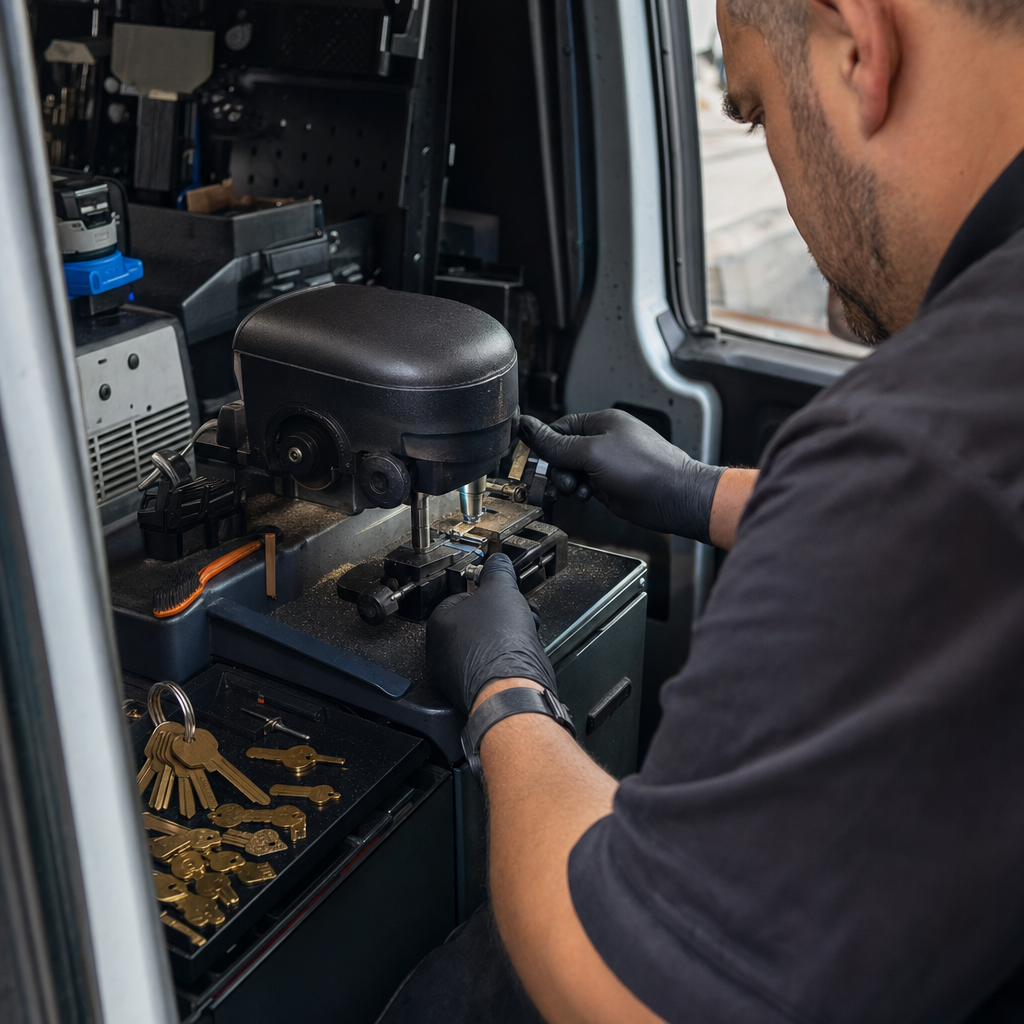
Transponder key duplication requires two distinct operations: cutting the physical blade to match the lock, and programming the chip to match the immobilizer. The first is mechanical and theoretically DIY-able with sufficient skill. The second is electronic and requires bidirectional communication with the vehicle’s computer.
Professional automotive locksmiths use devices like the Advanced Diagnostics Smart Pro, Autel IM608, or comparable platforms. These tools cost $3,000 to $8,000, receive monthly software updates for new vehicle models, and carry subscriptions running hundreds of dollars annually. The “programming tools” sold to consumers for $50-$200 are typically code readers with limited functionality, or outright scams.
Smart keys and proximity fobs raise the complexity further. These systems use encrypted rolling codes that change with every use, communicate over multiple frequencies, and often integrate with push-button start, steering lock, and alarm systems. Programming a replacement smart key for a 2020 Toyota Camry requires not just the right tool but the right software version, a stable power supply to the vehicle (battery voltage drop during programming causes failure), and knowledge of the specific sequence for that model year.
The failure modes are not graceful. A partially programmed transponder key may start the car once, then never again. A failed smart key programming can leave all keys nonfunctional, requiring tow to a dealer or mobile locksmith with dealer-equivalent capability. In Los Angeles traffic, where a tow from the 405 to the nearest dealer runs $150-$250 before any service, the original professional call-out fee - typically $120-$180 for transponder programming - looks modest in retrospect.
We have responded to dozens of these situations annually. The pattern is consistent: a car owner finds a “cheap” key online, attempts programming from a YouTube video, and ends up with a vehicle that cranks but won’t start, or that won’t recognize any key at all. The EEPROM - the chip storing key data - sometimes requires complete reflashing. This is not a user-serviceable procedure.
The Slim Jim Myth: Why DIY Lockout Methods Destroy Modern Cars
Television and film have preserved a dangerous anachronism: the image of a slim metal strip sliding between window glass and door seal, popping the lock in seconds. This method worked on vehicles through the 1980s. On modern vehicles, it is a reliable path to expensive damage.
Modern door construction incorporates multiple vulnerable components in the path of any inserted tool. Side-impact airbag sensors mount in the door shell and can be triggered by prying or probing. The wiring harness for power windows, mirrors, and locks runs in precisely the zone where a slim jim operates. Door lock rods, once simple mechanical linkages, now connect to electronic actuators with delicate plastic fittings.
The specific risks include:
- Airbag deployment or fault codes: A triggered side-curtain airbag costs $800-$1,500 to replace. An undeployed but damaged sensor stores a fault code that disables the entire airbag system until dealer reset.
- Window regulator damage: The cable-driven regulators in most vehicles since 2000 are not designed for lateral force. A slipped tool binds or snaps the cable, requiring door disassembly and $200-$400 in parts and labor.
- Paint and seal damage: Even a “professional” slim jim scratches paint and deforms rubber seals. On a Los Angeles vehicle, where sun exposure already stresses these materials, compromised seals lead to water intrusion and accelerated deterioration.
- Lock mechanism destruction: The electronic actuators in modern locks contain small motors and plastic gears. Forced movement strips gears or burns motors, converting a simple lockout into a lock replacement.
Professional locksmiths have largely abandoned slim jims for modern vehicles. At Strongbox Lock & Safe Co. home, our automotive technicians use air wedges and long-reach tools that create controlled access gaps, or pick the lock cylinder directly when accessible. These methods require training, practice, and specialized tools - not a coat hanger from the closet.
The Los Angeles angle matters here. Our climate produces specific conditions: baked rubber seals that crack under stress, dust infiltration that jams mechanisms, and the highest vehicle density per mile of any major U.S. city, meaning lockouts happen in inconvenient locations with limited safe workspace. A DIY attempt on the shoulder of the 101 at rush hour is not just technically risky; it is physically dangerous.
The True Cost of a DIY Mistake in Los Angeles
Understanding the financial exposure helps clarify when professional service is actually the economical choice. These figures reflect our direct experience serving the Los Angeles market.
| Service Scenario | Professional Cost (First Call) | Cost to Correct DIY Mistake |
|---|---|---|
| Transponder key programming (standard vehicle) | $120 - $180 | $350 - $650 (includes EEPROM recovery or dealer reflash) |
| Smart key / proximity fob programming | $180 - $280 | $500 - $900 (often requires dealer equipment) |
| Emergency lockout (standard vehicle) | $85 - $150 | $200 - $600 (window regulator, lock actuator, or airbag sensor replacement) |
| Ignition cylinder repair / replacement | $200 - $350 | $400 - $800 (if damaged by incorrect key forcing) |
| All-keys-lost recovery (immobilizer vehicle) | $250 - $450 | $600 - $1,200 (dealer tow, reflash, and new key set) |
The multiplier effect is consistent: correcting a DIY error typically costs 2.5 to 4 times the original professional service. This does not include the value of time, the inconvenience of an inoperable vehicle, or the safety exposure of being stranded in Los Angeles traffic.
Our flat-price model exists precisely because this trade has historically exploited these moments of vulnerability. The $19-ad locksmith scam - ubiquitous in Los Angeles - quotes a nominal arrival fee, then invents complications that inflate the final invoice to $300 or more. We quote the full price before our truck rolls. The price we quote is the price you pay.
What to Look for in a Professional Automotive Locksmith
Not all locksmith services are equivalent. The same market conditions that enable bait-and-switch pricing also produce wide variation in technical capability. Here is what distinguishes competent professional service.
Verifiable credentials. California requires locksmiths to hold a C-28 Lock and Security Equipment contractor license through the Contractors State License Board. Ask for the license number and verify it online. A legitimate technician presents identification at your door without prompting. This is standard practice for our team at Automotive Locksmith in Los Angeles.
Equipment transparency. A technician should be able to identify your vehicle’s immobilizer system and explain the programming method required. Vague assurances or reluctance to discuss technique are warning signs.
Written guarantee. Programming should be backed by a guarantee period during which the key is verified to function reliably. Our 90-Day Done Right Promise covers this: if the key does not perform, we return and correct it, no paperwork, no arguing.
Upfront pricing structure. The total cost should be quoted before dispatch, with clear distinction between service call, labor, and parts. Hidden fees for “programming,” “coding,” or “electronic service” that appear only on the invoice are the hallmark of predatory operators.
Brand knowledge. Automotive security increasingly intersects with residential and commercial hardware standards. A locksmith who understands the full ecosystem - from Schlage residential deadbolts to Sargent commercial systems to automotive transponder protocols - brings broader diagnostic capability. Residential Locksmith in Los Angeles and Commercial Locksmith in Los Angeles services share this integrated knowledge base.
Common Mistakes to Avoid
- Buying an “uncut, unprogrammed” key online. These listings dominate Amazon and eBay. The key blank is correct, but cutting requires a locksmith anyway, and programming requires equipment you do not have. The “savings” evaporate and the return window closes before you discover the problem.
- Attempting programming from a generic YouTube video. Vehicle-specific sequences vary by year, trim, and sometimes manufacturing plant. A video for a 2015 Honda Accord may not match your 2015 Accord LX made in a different month. One wrong step and you are locked out of the programming mode.
- Using a slim jim or coat hanger on any vehicle built after 2000. The risk-reward calculation is indefensible. Even if you succeed in opening the door, you have likely damaged something you cannot see until it fails later.
- Ignoring the “all keys lost” scenario. Many car owners attempt DIY duplication with their last working key, not considering what happens if that key is lost before the copy is made. An all-keys-lost situation requires more invasive and expensive recovery. Always maintain at least one fully functional spare, professionally programmed.
- Assuming the dealer is the only alternative to DIY. Dealer pricing for key programming is typically 40-100% above qualified locksmith rates, with longer wait times. Licensed automotive locksmiths invest in the same dealer-equivalent equipment and often complete the service while you wait.
- Neglecting fob battery replacement until failure. A weak battery causes intermittent operation that mimics more serious problems. Proactive replacement every 18 months in Los Angeles heat prevents the emergency call entirely.
When to Call a Professional
Call a professional automotive locksmith when your vehicle has an immobilizer and you need any key service beyond battery replacement. Call when you are locked out of any vehicle built after 2000. Call when your ignition is sticking, your key is worn, or your fob operates inconsistently. These are not character flaws or unnecessary expenses; they are the natural consequence of automotive security evolution.
In Los Angeles, where the pace of life does not accommodate a vehicle that won’t start, professional service is infrastructure maintenance, not luxury. Strongbox Lock & Safe Co. offers free estimates for automotive lock services - call (877) 664-8139 and we will quote your exact situation before any truck moves.
Frequently Asked Questions
Check for a chip icon on the key, a thick plastic key head, or a push-button start system. Vehicles built after 2007 are federally required to have immobilizers. For specific model years, Honda and Toyota adopted them widely by 1998, Ford by 1999, and GM in phases through 2007. Your owner’s manual will also list “engine immobilizer” or “anti-theft system” in the specifications section.
Professional-grade programming equipment costs $3,000 to $8,000 plus ongoing software subscriptions, and requires training to operate without risking ECM damage. Consumer-grade tools are unreliable and often vehicle-specific in ways not clearly disclosed. The economics do not support DIY for a single vehicle. Call (877) 664-8139 for a flat-price quote - it will cost less than the equipment, with zero risk of vehicle damage.
The most common cause is incorrect battery orientation. The second most common is a need for resynchronization between the fob and vehicle, required by some GM, Ford, and Chrysler models. Follow the resync procedure in your owner’s manual. If this does not resolve the issue within three attempts, stop and call a professional to avoid triggering anti-theft lockout.
Licensed automotive locksmiths typically charge 40-100% less than dealers for identical programming, with faster turnaround. Dealer service departments in Los Angeles often quote 3-5 day waits for key programming appointments. Mobile locksmiths complete most services same-day at your location.
Move to a safe location if possible, then call a licensed mobile locksmith. Do not attempt slim jim or coat hanger entry on any modern vehicle. The risk of airbag sensor damage, window regulator failure, or lock mechanism destruction far exceeds any perceived savings. Strongbox Lock & Safe Co. answers calls 24/7 with live operators, no voicemail trees.
Standard transponder key programming runs $120-$180. Smart key and proximity fob programming runs $180-$280. All-keys-lost recovery, which requires more invasive procedures, typically runs $250-$450. These are flat prices quoted before dispatch, with no hidden fees. Call (877) 664-8139 for your specific vehicle quote.
The Bottom Line
The automotive key has evolved from simple mechanical device to integrated electronic component, and for more guides & resources on navigating this complexity, visit our blog. This evolution protects your vehicle from theft but eliminates DIY viability for most key services. You can safely replace fob batteries, resync after battery changes, and duplicate purely mechanical keys for pre-immobilizer vehicles. Everything else - transponder programming, smart key creation, lockout entry, ignition work - demands professional equipment and training. The cost of correcting a DIY error consistently exceeds the cost of professional service by multiples. In Los Angeles, where vehicle reliability underpins daily life, getting it right the first time is not just convenient. It is essential.
Written by the team at Strongbox Lock & Safe Co., serving Los Angeles since 2013.