
How Keyless Entry Works in Los Angeles, From ADUs to Salt-Air Corrosion
A keyless entry lock reads your credential, verifies it against stored permissions, then triggers a small motor or electronic clutch to retract the bolt. In Los Angeles, where over 20,000 ADU permits were issued in a single year, the real question is not whether keyless entry works, but whether the lock behind your granny flat can actually reach your home’s Wi-Fi signal. If you’re weighing options for a detached unit or a rental property, call us at (877) 664-8139 and we’ll walk through the range test before we quote a flat price.
What Happens Inside the Lock When You Present a Credential
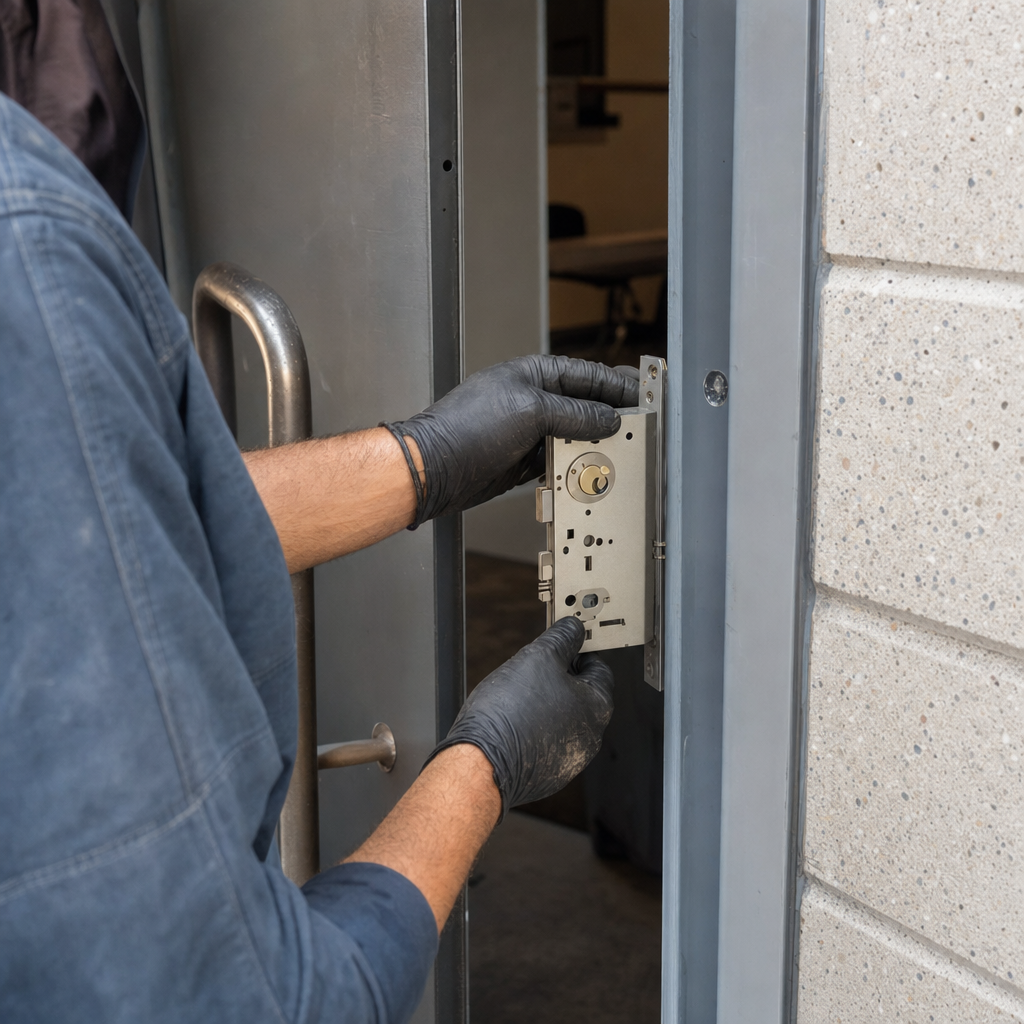
Every keyless lock, whether it’s a Schlage Encode on a Silver Lake bungalow or a Mul-T-Lock entry system on a Koreatown dingbat, follows the same basic sequence. The difference is in the mechanism that actually moves the bolt.
There are three credential types, and each triggers a different physical action:
- PIN code - You punch numbers on a capacitive or mechanical keypad. The lock’s microcontroller compares the entry against stored codes. Match confirmed, it signals a motor-driven bolt to retract. Battery draw is moderate; the motor runs only during entry.
- Fob or card (RFID/NFC) - The credential broadcasts a radio frequency. The lock’s reader picks it up, checks the encrypted ID, then releases an electronic clutch that lets you turn the lever manually. This uses less battery per entry than a full motor, but the reader draws standby power constantly.
- Smartphone (Bluetooth or Wi-Fi) - Your phone negotiates a encrypted handshake. On Wi-Fi models like the Schlage Encode, the lock connects through your router to a cloud server. The bolt is motor-driven, and the radio stays active for status updates. This is the highest battery drain and the most common failure point in ADU installations.
The mechanism matters because it determines what fails first. Motor-driven bolts wear out their gearbox after roughly 100,000 cycles. Electronic clutches fail when the solenoid burns out, usually from voltage spikes or salt-air corrosion on the contacts. In Venice and Playa del Rey, we see clutch failures two to three years earlier than in Pasadena or the Valley. The marine layer deposits microscopic salt crystals that bridge contacts and pit battery terminals. If you’re coastal, budget a shorter service interval and consider Abloy or Sargent hardware with sealed motor housings.
The ADU Problem Nobody Explains: Range, Power, and Separate Credential Sets
Los Angeles issued more ADU permits than any other U.S. city, driven by state housing laws targeting our shortage. A significant number of those new units get keyless locks. About half the calls we get afterward are because nobody thought through the gap between the main house router and the back unit.
Here’s the geometry. A detached ADU in Highland Park or Echo Park typically sits 50 to 100 feet from the main house, often through multiple walls and sometimes a stucco exterior. Standard Z-Wave mesh range is 100 feet line-of-sight with no obstructions. In practice, with walls and interference, that drops to 30 or 40 feet. Your smart lock cannot reach the hub. It cannot receive updates. It cannot log entries. It falls back to Bluetooth, which only works when you’re standing at the door.
The fixes are specific and cost real money:
| Solution | What It Does | Typical Range |
|---|---|---|
| Z-Wave range extender / bridge | Plugs into outlet between house and ADU | Adds 50-100 ft mesh hop |
| Wi-Fi lock with external antenna | Uses home network directly, stronger radio | Depends on router placement |
| Cellular-enabled lock (e.g., Schlage Encode Plus with optional module) | Independent of home network | Anywhere with LTE signal |
We always run a range test before quoting. Gil Navarro, Owner, Strongbox Lock & Safe Co. at Strongbox Lock & Safe Co., started doing this after too many callbacks in Los Feliz where the ADU lock worked fine during install, then dropped offline the moment the technician’s van left. The flat price we quote includes that test, plus a credential audit: one PIN or fob set for the ADU tenant, a completely separate set for the main house. Mixing them is the mistake that causes the second service call. Tenant moves out, landlord rekeys the ADU, accidentally wipes the main house credentials. For landlords managing multiple units, we often recommend a Master Key System to streamline access control. We’ve seen it a dozen times.
Power is the other ADU-specific headache. Many backyard units in Los Angeles run on separate electrical meters or sub-panels. A hardwired smart lock needs an electrician if there’s no low-voltage run to the door. Battery-powered is simpler until the battery dies and the tenant faces a Commercial Lockout at 11 PM. We specify locks with 9V emergency contacts on the exterior, and we always install a mechanical key override. In a rental or ADU context, the override is not optional. It’s the backup that keeps you from driving across town with a screwdriver.
What Happens When the Battery Dies
People ask this constantly, and the answer depends on the lock’s fail-state design.
Most residential keyless deadbolts are fail-secure: when power is lost, the bolt stays extended. The door remains locked. This is the safer default for an exterior door. You cannot get in without the 9V emergency contact, the mechanical key, or replacing the battery.
Some commercial electrified levers are fail-safe: power lost, bolt retracts automatically. These are coded for fire egress and require backup power supplies. We rarely recommend fail-safe for residential ADUs in Los Angeles unless the unit is part of a larger Commercial Locksmith in Los Angeles property with maintained UPS systems.
The 9V emergency contact is a pair of terminals on the lock’s exterior. Touch a fresh 9V battery to them, and the lock harvests just enough juice to run the credential check and retract the bolt once. It is a single-use rescue, not a solution. If your lock’s battery contacts are already corroded from salt air, the 9V contact may not conduct. We check this during seasonal tune-ups, which run $89 and include contact cleaning, strike alignment, and firmware updates on smart models.
How to Choose the Right Keyless System for Your Los Angeles Property
We’ve installed keyless entry on Craftsman bungalows with original mortise pockets too shallow for modern deadbolts, and on 1960s dingbats where the soft-story seismic retrofit shifted the frame so far out of plumb the bolt scraped the strike plate. The lock that works is the one that fits the door, the user, and the building’s specific conditions.
- Audit the door first. Is it solid core or hollow metal? Mortise or cylindrical prep? In Highland Park and Echo Park, 1920s bungalows often need custom faceplates or machined adapters to accept a Schlage or Mul-T-Lock keyless cylinder without damaging original trim.
- Test the signal path. For ADUs, walk the distance with a Wi-Fi analyzer app. If you’re below -70 dBm at the door, plan on a bridge or cellular lock.
- Separate the credential domains. Main house gets one master code set. ADU gets its own. No overlap, no shared fobs. We document both on paper, sealed in the job file.
- Specify the override. Mechanical key cylinder, 9V contact, or both. For rentals, we require both.
Our 90-Day Done Right Promise covers every install: if the lock drops offline, binds, or fails to credential, we come back. No paperwork, no arguing. We stand behind it.
FAQs
Most Best Commercial Locksmith in Los Angeles, CA residential keyless deadbolt installs run between $280 and $520, including the lock, labor, range testing, and credential setup. ADU installations with bridge devices or cellular modules add $120 to $240. We quote flat prices on the phone before the truck rolls - the price on the invoice matches the price you heard. Call (877) 664-8139 for an exact quote; estimates are free.
Yes. PIN-code and RFID fob locks operate entirely offline. Bluetooth smart locks work without Wi-Fi if you’re within 30 feet. Wi-Fi-dependent models like the Schlage Encode will not function remotely without internet, though most retain local PIN entry as fallback. For ADUs with unreliable signal, we often specify offline PIN or cellular-enabled locks to eliminate the dependency entirely.
Not inherently, but the failure modes differ. A mechanical deadbolt fails by wearing out its pins or breaking its key. A keyless lock fails by battery depletion, firmware bug, or radio interference. The physical bolt in most quality keyless units is equivalent to a Grade 2 deadbolt. The vulnerability is usually credential management - shared PINs, unrevoked fobs, or default admin codes never changed. We include a credential audit with every install to close these gaps.
Inland, expect 8 to 12 months on four AA batteries for a motor-driven deadbolt with moderate use. In Venice, Mar Vista, or Playa del Rey, salt-air corrosion on contacts and higher humidity affecting circuit boards shortens that to 5 to 8 months. We recommend lithium AAs for coastal installs and schedule reminder calls at six months. Our $89 seasonal tune-up includes battery replacement, contact cleaning, and strike alignment.
If you’re considering keyless entry for a main house, ADU, or rental property in Los Angeles, our Commercial Locksmith services team will walk through the specifics over the phone. Tell me what you need. We will give you a price before we move, and we will stand behind the work when it is done. Call (877) 664-8139 - a live person answers, 24/7, including nights, weekends, and holidays.
Written by Gil Navarro, Owner at Strongbox Lock & Safe Co., serving Los Angeles, CA.