
Last updated July 25, 2026
DIY vs Professional Commercial Locksmith: What’s Safe to Do Yourself
A business owner in Los Angeles installs a double-cylinder deadbolt on their commercial exit door after a break-in, thinking they’ve tightened security. They’ve actually created an illegal egress condition under California fire code, exposing themselves to permit violations, failed inspections, and personal liability if someone cannot exit during a fire. In 42 years of serving Los Angeles businesses, we’ve seen this exact scenario more times than we can count. This guide explains which commercial lock tasks you can handle yourself without risking code violations, insurance claim denials, or ADA lawsuits, and which ones require a licensed professional who understands the regulatory landscape. For related reading, see our DIY vs Professional Emergency Locksmith: What’s Safe to Do Yourself.
Quick Answer
Commercial lock tasks that are safe to DIY are limited to battery replacement in standalone keypads, credential programming in user-managed access systems, and basic door closer speed adjustments on non-fire-rated interior doors. Everything else, including exit device replacement, fire-rated door hardware, master-key system changes, and electronic access on primary egress routes, requires a licensed Commercial Locksmith services provider to maintain code compliance and insurance coverage.
Table of Contents
- The Liability Factor: Why Commercial DIY Is Different From Residential
- Commercial Lock Tasks You Should Never DIY
- Commercial Lock Tasks That Are Actually Safe to DIY
- How Commercial Insurance Treats Self-Performed Security Work
- The Real Cost Comparison: Labor vs. Failed Inspections and Lawsuits
- How to Evaluate a Commercial Locksmith Proposal in Los Angeles
- Common Mistakes to Avoid
- When to Call a Professional
- Frequently Asked Questions
- The Bottom Line
The Liability Factor: Why Commercial DIY Is Different From Residential
Homeowners in Silver Lake or Pasadena who rekey their own front door accept personal risk. If the lock fails, they call a locksmith and fix it. Business owners face a fundamentally different equation. Every commercial door in Los Angeles falls under overlapping jurisdictions: the Los Angeles Fire Department enforces California Building Code egress requirements, the Department of Building and Safety enforces accessibility standards, and your commercial general liability policy contains specific exclusions for unlicensed trade work.
The liability chain works like this. A self-installed exit device that fails to release during an emergency creates three simultaneous exposures:
- Code violation fines from LAFD or LADBS, which start at roughly $500 per occurrence and escalate for repeat issues
- Personal liability for the business owner if injury occurs, since workers’ compensation may not cover incidents stemming from unpermitted hardware modifications
- Insurance claim denial if the carrier determines the loss resulted from work performed outside policy terms
California Business and Professions Code Section 6980 requires locksmiths to hold a state license for any work involving “locks, safes, vaults, or similar security devices” in commercial settings. While enforcement against a business owner working on their own property is rare, the licensing requirement exists because the state recognizes this work as carrying public safety implications. Your DIY deadbolt installation isn’t just a private decision; it affects employees, customers, and emergency responders.
We’ve responded to calls in Downtown Los Angeles where a property manager’s self-installed panic hardware failed inspection, delaying a certificate of occupancy for three weeks. The lost rent exceeded what professional installation would have cost by a factor of ten. The liability factor isn’t theoretical. It’s arithmetic.
Commercial Lock Tasks You Should Never DIY
These tasks create code, insurance, or operational liability that a business owner cannot reasonably assume. A licensed commercial locksmith carries the errors and omissions coverage, maintains current code knowledge, and assumes professional responsibility for the installation.
Exit Device Replacement or Repair
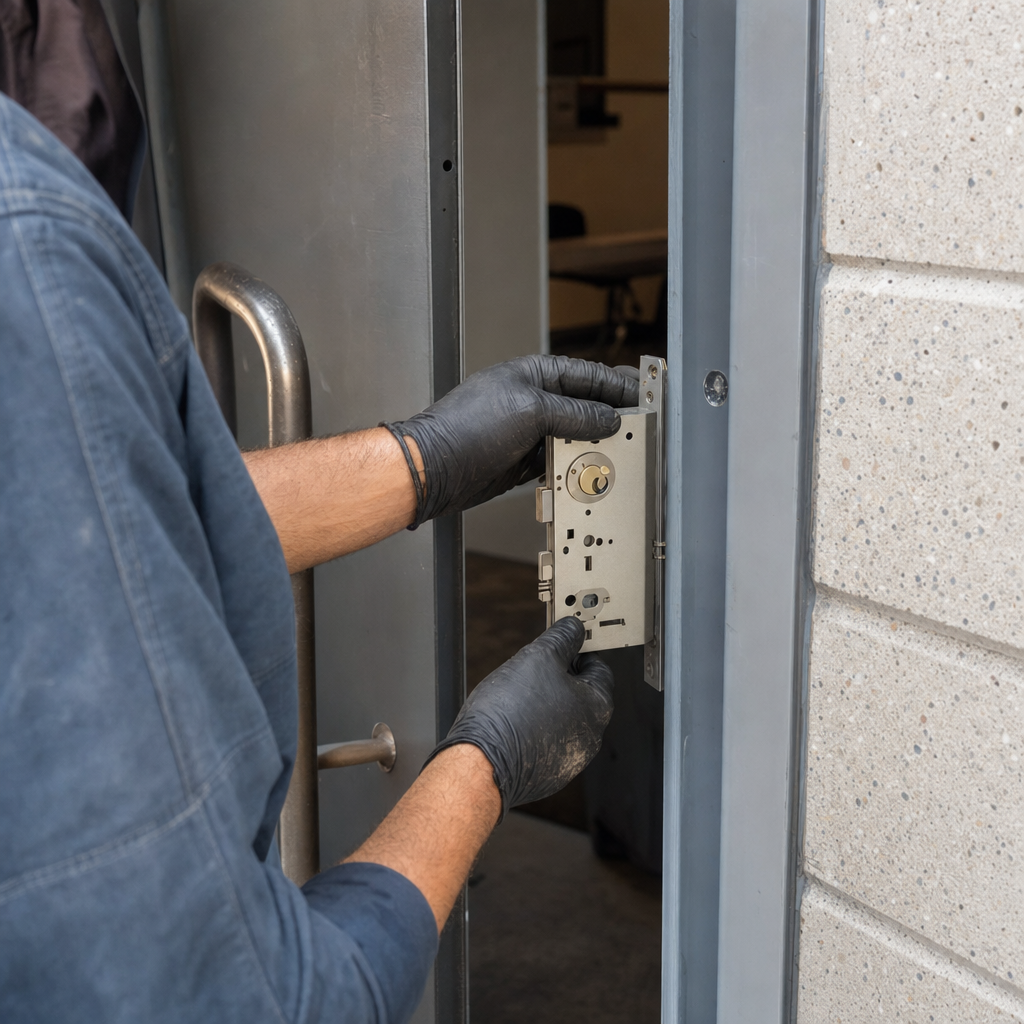
Panic bars and touchpad exit devices must comply with NFPA 101 (Life Safety Code) and California Title 24. The device must release with a single motion, require no prior knowledge to operate, and maintain positive latching. A common DIY error is installing a rim device with the wrong strike depth, which appears to function in normal use but fails under pressure or after settling. We’ve replaced improperly installed exit devices in Koreatown restaurants and Arts District warehouses where the owner assumed “it seems to work” was sufficient.
Any Hardware on a Fire-Rated Door
Fire-rated doors require listed hardware installed per the manufacturer’s fire door hardware schedule. Removing or modifying any component, including the latch, closer, or hinges, voids the rating. Los Angeles Fire Department inspectors check these doors annually in most commercial occupancies. A failed inspection triggers a re-inspection fee and potential business closure until correction.
Master-Key System Changes
Adding, removing, or rekeying cylinders in a master-key system requires understanding the system’s bitting hierarchy. A single incorrect pin placement can create a “cross-key” condition where multiple keys operate a cylinder unpredictably. In a Los Angeles medical office or law firm, this isn’t just inconvenient; it’s a potential HIPAA or client confidentiality breach.
Electronic Access on Primary Egress
Access control on egress routes must fail-safe (unlock on power loss) per NFPA 101, with manual override capability. Standalone keypad installations on exit doors frequently violate this requirement. The credential reader you bought online almost certainly doesn’t include the required request-to-exit sensor and delayed-egress timing module.
ADA-Related Hardware Modifications
Any change to door opening force, handle height, or latch operation must maintain ADA compliance. California’s accessibility standards exceed federal requirements in several respects, including maximum opening force and lever handle dimensions. A self-installed lever that feels “easier to use” may still violate the precise dimensional and force requirements.
Commercial Lock Tasks That Are Actually Safe to DIY
These tasks don’t affect code compliance, don’t modify listed fire-rated assemblies, and don’t create insurance exposure when performed correctly. They’re also the tasks where professional dispatch fees represent a disproportionate share of total cost.
Battery Replacement in Standalone Keypads
Most standalone electronic locks use four AA batteries or a 9-volt cell, accessible via a interior-side cover. Replace batteries when you hear the low-battery tone, typically six to twelve months after installation. Use alkaline or lithium cells as specified; rechargeable batteries often don’t provide sufficient voltage under load. Keep a record of replacement dates.
Credential Programming in User-Managed Systems
Many commercial access systems, including entry-level Schlage and Kwikset commercial products, allow end-user programming of PINs or keycards through documented keypad sequences. The critical distinction: you’re adding or deleting credentials within the manufacturer’s defined parameters, not modifying the system’s fundamental operation. Keep the programming manual accessible and don’t exceed the stated user capacity.
Door Closer Speed Adjustment on Non-Fire-Rated Interior Doors
Standard surface-mounted door closers have two adjustment valves: sweep speed (main closing motion) and latch speed (final few inches). Use a small flathead screwdriver to turn the valves clockwise to slow, counterclockwise to speed up. Test the door through multiple cycles. This adjustment is safe on interior office doors that aren’t part of a rated assembly. Never adjust closers on fire doors; the factory setting maintains the required positive latching pressure.
Basic Maintenance
Annual lubrication of hinges and latch bolts with dry graphite or Teflon-based lubricant prevents binding. Tighten visible screws. These tasks don’t alter function or compliance status.
How Commercial Insurance Treats Self-Performed Security Work
Your commercial general liability policy contains language you probably haven’t read carefully. Standard ISO-form CGL policies include exclusions for “work performed by or on behalf of the insured” outside the insured’s business operations. More specifically, many policies exclude bodily injury or property damage “arising out of the rendering of or failure to render professional services” by unqualified persons.
What this means in practice: if your self-installed exit device contributes to an injury during an emergency, your carrier may deny the claim on the basis that you performed locksmith work without a license, or that the work constituted an uninsurable professional service. We’ve reviewed claim denials in Los Angeles where the carrier cited exactly this exclusion.
Before performing any commercial lock work yourself, request a copy of your policy’s “professional services” and “your work” exclusions. Ask your broker specifically: “Does this policy cover liability arising from self-installed security hardware?” Document the response. If your broker hesitates or deflects, that’s your answer.
Property policies are equally relevant. A burglary where the insurer’s investigation reveals non-compliant or self-installed hardware may result in reduced recovery or denial, on the theory that the insured failed to maintain reasonable security measures. The standard isn’t whether the lock “worked” in your assessment; it’s whether the installation met industry standards and code requirements.
The Real Cost Comparison: Labor vs. Failed Inspections and Lawsuits
The DIY savings calculation most business owners perform is incomplete. It compares a $150 service call against a $40 hardware purchase, concluding DIY saves $110. The accurate comparison includes downstream costs that materialize with meaningful probability.
| Scenario | Professional Cost | DIY Cost (Including Downstream Risk) |
|---|---|---|
| Exit device installation, standard commercial door | $280-$450 including hardware (Schlage or Sargent grade) | $120 hardware + $500 re-inspection + $2,000+ delayed occupancy + potential liability exposure |
| Fire-rated door hardware replacement | $350-$600 with proper listing documentation | $80 hardware + rating voided + potential code enforcement action |
| Master-key system rekey, 5-cylinder small office | $200-$350 | $30 pin kit + cross-key liability + potential security breach remediation |
| Electronic access, single door primary egress | $800-$1,400 with code-compliant fail-safe integration | $400 online hardware + failed inspection + insurance exposure + potential injury liability |
In Los Angeles specifically, factor the accelerated inspection timeline. LADBS and LAFD both maintain substantial backlogs. A failed inspection doesn’t mean a next-day re-inspection; it means rejoining the queue, which currently runs two to four weeks for non-priority commercial work. For a retail tenant in Westwood awaiting certificate of occupancy to open, that delay is existential.
The cost comparison that matters isn’t labor versus parts. It’s professional execution versus the compound cost of failure: direct correction, regulatory delay, lost revenue, and unquantifiable liability exposure.
How to Evaluate a Commercial Locksmith Proposal in Los Angeles
Not every professional proposal represents competent work. The Los Angeles market includes legitimate operators, marginally qualified handymen, and outright scams. A proper proposal distinguishes the first category from the others.
A legitimate commercial locksmith scope of work includes these elements:
- Hardware specifications by manufacturer and model - “install panic hardware” is insufficient; “install Sargent 8800 rim exit device, satin chrome finish” is specific and verifiable
- Code compliance statement - explicit reference to applicable standards (NFPA 101, California Title 24, ADA Standards) with brief explanation of how the proposed hardware satisfies them
- Warranty terms - parts and labor coverage period, with clear statement of what triggers warranty service
- Licensing and insurance verification - California locksmith license number, general liability and workers’ compensation certificates
- Flat price with no open-ended components - the price quoted is the price invoiced, with defined conditions for any change order
Proposals to reject include: a single number with no hardware specification; pressure to decide immediately; arrival in an unmarked vehicle; refusal to provide license information; or any “service call” quote that seems designed to get a foot in the door before the real pricing begins.
Commercial locksmith work in Los Angeles requires familiarity with local enforcement practices. LAFD inspectors in the San Fernando Valley, for instance, routinely check for proper exit device dogging functions that Downtown inspectors may overlook. A locksmith who works across Los Angeles understands these variations and prepares accordingly.
Common Mistakes to Avoid
- Installing double-cylinder deadbolts on any commercial exit door. In most California occupancies, this creates a single-motion egress violation. We’ve removed these in Los Angeles auto repair shops and small manufacturing facilities where the owner wanted “extra security” after a burglary.
- Assuming “heavy duty” hardware is automatically code-compliant. Grade 1 hardware from a reputable manufacturer like Mul-T-Lock or Abloy meets durability standards but may still violate egress or accessibility requirements if improperly applied.
- Modifying fire-rated doors without checking the hardware schedule. The label inside the door frame specifies approved hardware. Deviations void the rating, and inspectors in Los Angeles commercial buildings increasingly verify this documentation.
- Buying access control hardware online without understanding fail-safe requirements. That magnetic lock with the attractive price almost certainly requires a separate request-to-exit device and delayed-egress timer for code compliance on egress routes.
- Failing to document professional work for insurance purposes. Even properly installed hardware creates coverage disputes if you can’t prove who performed the work and when. Maintain invoices, permits, and inspection certificates.
- Ignoring the interaction between new hardware and existing master-key systems. A new cylinder that isn’t properly pinned to the existing hierarchy can create unpredictable keying conflicts across your facility.
When to Call a Professional
Call a licensed commercial locksmith when any task affects egress, fire rating, accessibility compliance, or your master-key system’s integrity. Call when your insurance policy requires professional installation for coverage. Call when the cost of delay, failed inspection, or liability exposure exceeds the service fee by any meaningful margin.
In Los Angeles, where code enforcement is active and insurance carriers are increasingly attentive to security hardware documentation, professional installation is rarely the expensive option. It’s the option that prevents expensive problems.
Strongbox Lock & Safe Co. offers free estimates for commercial lock work throughout Los Angeles. Our technicians are background-checked, uniformed, and carry state locksmith licenses. We quote a flat price on the phone before any truck rolls, and every job is backed by our 90-Day Done Right Promise in writing. If you’re uncertain whether a task is appropriate for DIY, call us at (877) 664-8139. We’ll tell you straight whether you need us or not.
Frequently Asked Questions
California law requires a locksmith license for commercial lock work, though enforcement against property owners working on their own buildings is uncommon. The practical issue isn’t legality of installation; it’s liability if the installation fails or violates code. Your commercial insurance may not cover incidents stemming from unlicensed work, and you assume full personal liability for any injuries or code violations.
Standard commercial deadbolt or lever installation typically runs $180-$320 including hardware. Exit device installation ranges $280-$450. Electronic access control on a single door starts around $800 for code-compliant installation with fail-safe integration. Call (877) 664-8139 for a flat-price quote specific to your door and hardware requirements; estimates are free.
Commercial property policies generally cover burglary damage regardless of who installed the locks, but may reduce recovery or deny claims if the insurer determines your installation was negligent or non-compliant with applicable codes. The critical policy language is in the “neglect” or “reasonable precautions” clause. Self-installed hardware that clearly violates fire or accessibility codes creates coverage vulnerability that a professional installation with documentation does not.
Verify the California locksmith license through the Bureau of Security and Investigative Services. Request proof of general liability and workers’ compensation insurance. Confirm the proposal specifies hardware by manufacturer and model, references applicable code compliance, and states warranty terms in writing. Ask whether the price quoted is the complete price, with no additional service fees or trip charges.
Repair is economical when the issue is isolated: a broken spring in a lever, a worn cam in a mortise lock, or a damaged cylinder. Replacement is indicated when the lock body is worn, the hardware is obsolete and parts are unavailable, or the existing hardware doesn’t meet current code or security requirements. For locks over fifteen years old, replacement with current-grade hardware often costs only slightly more than repair and provides updated security and compliance. Call (877) 664-8139; we’ll assess your specific hardware and give you straight guidance.
Yes. We design, implement, and maintain master-key systems for commercial properties throughout Los Angeles, from small professional offices to multi-building industrial complexes. Our systems use top-tier cylinders from manufacturers including Schlage, Mul-T-Lock, and Sargent, with full documentation and key control protocols. Every installation is backed by our 90-Day Done Right Promise. Learn more about our commercial locksmith services in Los Angeles.
The Bottom Line
Commercial lock DIY is constrained by a regulatory and liability environment that residential work simply doesn’t face. For a deeper comparison, read our DIY vs Professional Lock Installation & Rekey: What’s Safe to Do Yourself. The safe zone for self-performance is narrow: battery changes, user-level credential management, and minor non-fire-door closer adjustments. Everything that affects life safety, accessibility, or your insurance coverage belongs with a licensed professional who documents compliance and assumes professional responsibility. In Los Angeles, where inspections are rigorous and liability exposure is real, the question isn’t whether you can install a lock. It’s whether you can afford to own the consequences if it’s wrong.
Written by the team at Strongbox Lock & Safe Co., serving Los Angeles since 2013. Explore our more guides & resources.